
Search
Did you mean: Thera?
Remove Ads
Advertisement
Search Results

Article
The Impact of the British Industrial Revolution
The consequences of the British Industrial Revolution (1760-1840) were many, varied, and long-lasting. Working life in rural and urban settings was changed forever by the inventions of new machines, the spread of factories, and the decline...

Article
Social Change in the British Industrial Revolution
The British Industrial Revolution (1760-1840) witnessed a great number of technical innovations, such as steam-powered machines, which resulted in new working practices, which in turn brought many social changes. More women and children worked...
Article
Ancient Roman Family Life
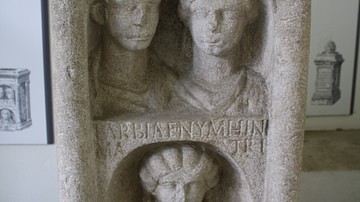
Whether there was a king, a consul, or an emperor that stood supreme over Rome and its territories, the one constant throughout Roman history was the family. Like many earlier societies, the family was the fundamental social unit in the eternal...

Article
The Plague at Athens, 430-427 BCE
In the second year of the Peloponnesian War, 430 BCE, an outbreak of plague erupted in Athens. The illness would persist throughout scattered parts of Greece and the eastern Mediterranean until finally dying out in 426 BCE. The origin of...

Article
Plague in the Ancient & Medieval World
The word 'plague', in defining a lethal epidemic, was coined by the physician Galen (l. 130-210 CE) who lived through the Antonine Plague (165 - c. 180/190 CE) but the disease was recorded long before in relating the affliction of the Plague...

Article
Slavery in Plantation Agriculture
The first plantations in the Americas of sugar cane, cocoa, tobacco, and cotton were maintained and harvested by African slaves controlled by European masters. When African slavery was largely abolished in the mid-1800s, the center of plantation...

Article
The Armies of the East India Company
The East India Company (EIC) was first England's and then Britain's tool of colonial expansion in India and beyond. Revenue from trade and land taxes from territories it controlled allowed the EIC to build up its own private armies, collectively...

Article
The Early History of Clove, Nutmeg, & Mace
The spices clove, nutmeg, and mace originated on only a handful of tiny islands in the Indonesian archipelago but came to have a dramatic, far-reaching impact on world trade. In antiquity, they became popular in the medicines of India and...

Article
Plague of Cyprian, 250-270 CE
The Plague of Cyprian erupted in Ethiopia around Easter of 250 CE. It reached Rome in the following year eventually spreading to Greece and further east to Syria. The plague lasted nearly 20 years and, at its height, reportedly killed as...

Article
The Temple of the Emerald Buddha
A small carved figurine sits high on a grand multi-tiered pedestal in a magnificent wat (temple) in Bangkok, Thailand. It has been sitting there since 1784 CE and was originally thought to be made of emerald. Hundreds of tourists and pilgrims...
