
Search
Search Results

Definition
Byzantine Emperor
The Byzantine Emperor ruled as an absolute monarch in an institution which lasted from the 4th to 15th century CE. Aided by ministers, high-ranking nobility, and key church figures, the emperor (and sometimes empress) was commander-in-chief...
Definition
Peace of Westphalia
The Peace of Westphalia, the name given to the multiple treaties, marked the conclusion of the Thirty Years' War. Signed on 24 October 1648, it aimed to secure political autonomy for the multitude of small states that made up the Holy Roman...

Definition
Viking Raids on Paris
Throughout the 9th century CE, Viking raids on the region of Francia (roughly modern-day France) increased in frequency, destabilizing the region, and terrorizing the populace. The raids seem to have been inspired by the death of the Holy...
Image
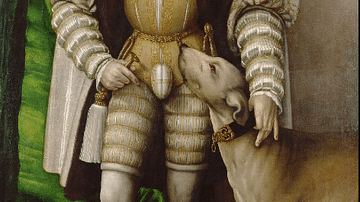
Charles V, Holy Roman Emperor
A 1532 portrait by Jakob Seisenegger of Charles V, Holy Roman Emperor (r. 1519-56) with his dog. (Kunsthistorisches Museum, Vienna)
Image
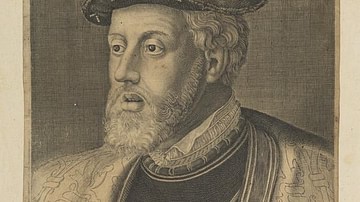
Charles V, Holy Roman Emperor
Portrait of Charles V, Holy Roman Emperor (1500-1558), line engraving on paper by Barthel Berham.
Scottish National Portrait Gallery, Edinburgh.
Image
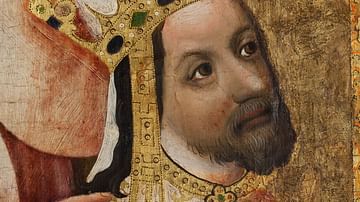
Charles IV, Holy Roman Emperor
Part of Votive Panel of Jan Očko of Vlašim depicting Charles IV.
Tempera on limewood, before 1371.
National Museum, Prague.

Article
The Legacy of Charles Martel & the Battle of Tours
The Battle of Poitiers aka the Battle of Tours took place over roughly a week in early October of 732. The opposing sides consisted of a Frankish army led by Charles Martel (r. 718-741) against an invading Muslim army under the nominal sovereignty...

Definition
Emperor of Japan
The emperor of Japan is a position as the head of state which traditionally dates back to the 7th century BCE and the legendary figure of Emperor Jimmu (r. 660-585 BCE). Emperors came to be known as the Tenno or 'heavenly sovereign' in reference...

Definition
Western Roman Empire
The Western Roman Empire is the modern-day term for the western half of the Roman Empire after it was divided in two by the emperor Diocletian (r. 284-305 CE) in c. 285/286 CE. The Romans themselves did not use this term. At its height (c...

Definition
Yongle Emperor
The Yongle Emperor (aka Chengzu or Yung Lo, r. 1403-1424 CE) was the third ruler of the Chinese Ming Dynasty (1368-1644 CE). Inheriting a stable state thanks to the work of his father, the Hongwu Emperor (r. 1368-1398 CE), Yongle made lasting...
