
Search
Remove Ads
Advertisement
Search Results

Definition
Neo-Assyrian Empire
The Neo-Assyrian Empire (912-612 BCE) was the final stage of the Assyrian Empire, stretching throughout Mesopotamia, the Levant, Egypt, Anatolia, and into parts of Persia and Arabia. Beginning with the reign of Adad Nirari...

Definition
Ancient Egyptian Literature
Ancient Egyptian literature comprises a wide array of narrative and poetic forms including inscriptions on tombs, stele, obelisks, and temples; myths, stories, and legends; religious writings; philosophical works; wisdom...

Definition
Gottfried Wilhelm Leibniz
Gottfried Wilhelm Leibniz (1646-1716) was a German polymath who became well-known across Europe for his work, particularly in the fields of science, mathematics, and philosophy. Leibniz's rationalist philosophy attempted...

Article
Visitor’s Guide to the Monuments of Hadrian’s Villa
Hadrian’s Villa near Tivoli, Italy, is an opulent, sprawling garden-villa covering some 120 hectares (296 acres). It was built by Emperor Hadrian (76-138 CE) between 125-134 CE for use as his country...

Article
Poor Man of Nippur - What Does One Deserve?
The Poor Man of Nippur (circa 701 BCE) is a Babylonian poem on the themes of the obligations of hospitality and revenge for an undeserved injury. A poor man of the city of Nippur feels mistreated when he visits...
Image
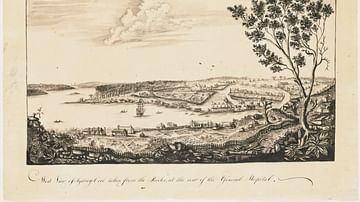
Sydney Cove 1789
West view of Sydney Cove taken from The Rocks at the rear of the General Hospital (1789).
Image
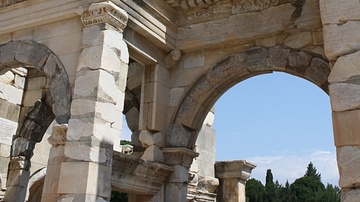
Agora Gate, Ephesos
The Mazeus-Mithridates Gate, consisting of three arched entrances, led from the library of Celsus to the Roman Agora of Ephesos. It was built by and named after two emancipated slaves of emperor Augustus in 4 or 3 BCE, who...
Image
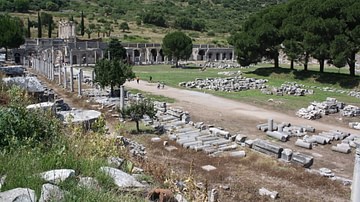
Roman Agora, Ephesus
The Agora (or market place) of Ephesos was first built in the 3rd century BC but was adapted over the Roman period to reach its final form in the early 3rd century AD. On a square plan (111m x 111m) the Agora was accessible...

Image
Curetes Street, Ephesos
Leading from the Heracles Gate to the Celsus Library, Curetes street (named after the priest class of Ephesos) was lined with colonnaded galleries, various temples, store rooms and houses, and statues of the city's benefactors...

Definition
Nineveh - The Great Cultural Center That Became the "City of Sin"
Nineveh (modern-day Mosul, Iraq) was one of the oldest and greatest cities in antiquity. It was originally known as Ninua, a trade center, and would become one of the largest and most affluent...
