
Search
Search Results
Image
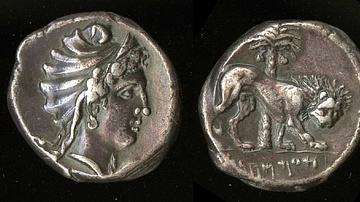
Dido, Carthaginian Tetradrachm
A silver tetradrachm from Carthage. The female head has been identified by some historians as Dido (Elissa), the legendary founder of the city. Other historians identify the figure as the goddess Tanit (aka Tinnit). She wears a Phrygian cap...
Image
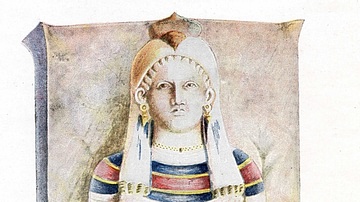
Priestess of Isis on a Carthaginian Sarcophagus Lid
An illustration of a sarcophagus lid from Carthage depicting a priestess of Isis. (Carthage National Museum, Byrsa, Tunisia)
Image
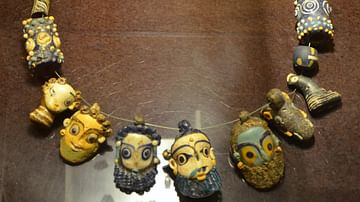
Carthaginian Necklace
A necklace of glass paste beads, Carthage, 4th-3rd century BCE. (National Archaeological Museum, Cagliari)
Image
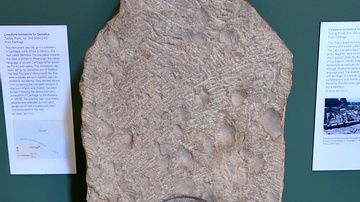
Carthaginian Tombstone for Gemellus
This limestone monument was set up in a cemetery in Carthage, in memory of a man called Gemellus. The inscription towards the base is written in Phoenician, the native language of ancient Carthage, often known as Punic, and states "This tombstone...
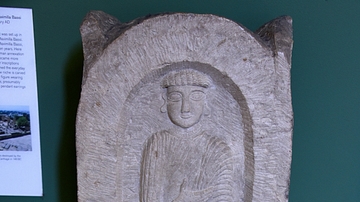
Image
Carthaginian Tombstone for Maximilla Bassi
This finely carved limestone monument was set up in a memory for a woman called Maximilla Bassi. The Latin inscription says "Maximilla Bassi, Pious daughter, lived nineteen years. Here she is placed". After the Roman annexation of Carthage...

Definition
Scipio Africanus the Elder
Scipio Africanus Major (l. 236-183 BCE) received his epithet due to his military victories in Africa which won the Second Punic War for Rome against Carthage. He is also known as Scipio the Elder. He was born Publius Cornelius Scipio in 236...

Definition
Agathocles of Syracuse
Agathocles of Syracuse (c. 361 - 289 BCE) ruled as tyrant of the Sicilian city for over 25 years. Ambitious, unprincipled, and seeing himself as a new Alexander, he famously attacked Carthage in a three-year campaign and made conquests in...

Image
Ancient Roman Society and Social Order
This infographic illustrates the complexity and layered dynamics of Ancient Roman society. Structured by wealth, citizenship, ancestry, political privilege, and freedom, Roman social order was rigid yet fluid. Although status was sharply...

Image
Voyage of Hanno the Carthaginian Explorer
A map indicating the possible route of Hanno, a Carthaginian who led a colonising and exploration expedition down the Atlantic coast of Africa in the 6th or 5th century BCE. Some scholars suggest he reached modern Sierra Leone, others that...

Image
The Feudal Society in Medieval Europe - Power in Medieval Europe: Lords, Land & the Church
The social structure of medieval Western Europe (c. 10th–13th centuries) is often described through the framework of feudal relationships and landholding systems that linked rulers, nobles, and rural communities. In this model, political...
