
Search
Did you mean: Brahma?
Search Results

Definition
Ashoka the Great
Ashoka the Great (r. 268-232 BCE) was the third king of the Mauryan Empire (322-185 BCE) best known for his renunciation of war, development of the concept of dhamma (pious social conduct), and promotion of Buddhism as well as his effective...
Definition
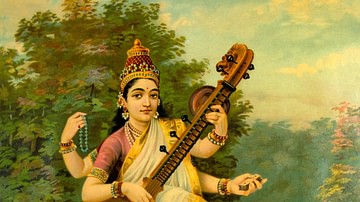
Saraswati
Saraswati (also Sarasvati) is the Hindu goddess of learning, wisdom, music, and aesthetics. She is also known as Bharati (eloquence), Shatarupa (existence), Vedamata ('mother of the Vedas'), Brahmi, Sarada, Vagisvari, and Putkari. As Vac...

Definition
Maukhari Dynasty
The Maukharis (554 CE - 606 CE) rose as a power after the downfall of the Gupta Empire (3rd to 6th century CE) in the 6th century CE in northern India. The core area of their kingdom was situated in what is now the state of Uttar Pradesh...

Definition
White Huns (Hephthalites)
The White Huns were a race of largely nomadic peoples who were a part of the Hunnic tribes of Central Asia. They ruled over an expansive area stretching from the Central Asian lands all the way to the Western Indian Subcontinent. Although...

Definition
Kapilavastu
Kapilavastu (“Place of Kapila”) is the name of the city where Siddhartha Gautama (the Buddha, l. c. 563-483 BCE) grew up and lived for the first 29 years of his life before leaving to pursue the spiritual path which led to his enlightenment...

Definition
Lumbini
Lumbini is a village, archaeological site, and place of pilgrimage honored as the birthplace of Siddhartha Gautama (the Buddha, l. c. 563-483 BCE) located in modern-day Rupandehi District of Nepal, Province 5, near the Indian border. It was...

Article
The Ajanta Caves
The 30 caves at Ajanta lie to the north of Aurangabad in the Indhyadri range of Western Ghats. The caves, famous for their temple architecture and many delicately drawn murals, are located in a 76 m high, horseshoe-shaped escarpment overlooking...
Image
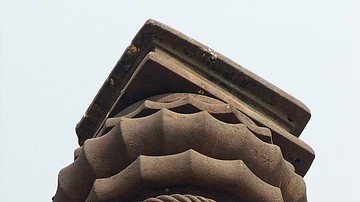
Iron Pillar of Delhi
The Iron Pillar in Qutub Complex, Delhi is a stellar example of advanced metallurgy technology in Gupta Period (circa 320 - 550 CE). The 7 m (23 ft) high pillar was made corrosion resistant. It bears Sanskrit - Brahmi inscriptions eulogising...
