
Search
Remove Ads
Advertisement
Search Results

Definition
Horyuji
The Horyuji Temple near Nara in Japan was founded in 607 CE by Prince Shotoku and is the only surviving Buddhist monastery from the Asuka Period in its original state. The complex, consisting of 48 listed buildings including a 5-storey pagoda...

Definition
Seokguram Grotto
The Seokguram Grotto (Sokkuram) is a Buddhist cave temple constructed during the Unified Silla Period (668-935 CE) of ancient Korea. The 8th-century CE structure, located near the Bulguksa Temple on Mt. Toham at the ancient Silla capital...
Definition
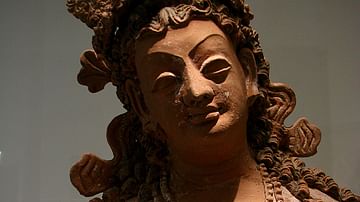
Mahasanghika
Mahasanghika (“Great Congregation”, also given as Mahasamghika) was an early Buddhist school of thought which is thought to have been formed after the Second Buddhist Council of 383 BCE when it separated itself from another school, the Sthaviravada...
Definition
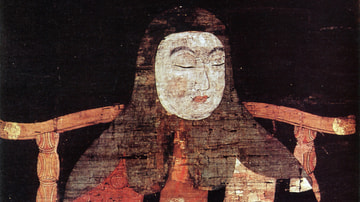
Saichō
Saichō, also known as Dengyo Daishi (767-822 CE), was a monk and scholar who founded the Buddhist Tendai Sect in Japan. Based on the teachings of the Chinese Tiantai Sect, Saichō's simplified and inclusive version of Buddhism grew in popularity...

Article
Cultural Links between India & the Greco-Roman World
Cyrus the Great (558-530 BCE) built the first universal empire, stretching from Greece to the Indus River. This was the famous Achaemenid Empire of Persia. An inscription at Naqsh-i-Rustam, the tomb of his able successor Darius I (521-486...

Article
15 Complete Hyangga Songs from Ancient Korea
Hyangga was a form poetical 'country song,' distinct from contemporary Chinese songs, which were written in the Silla and Goryeo kingdoms of ancient Korea between the 7th and 10th century CE. The indigenous songs cover such topics as love...
Image
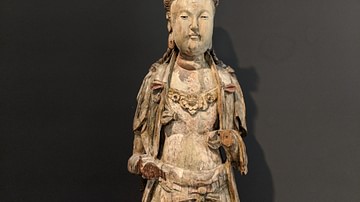
Guanyin, Song Dynasty
Guanyin, the Bodhisattva of Compassion. Song Dynasty (960-1279 CE), China. Wooden, painted and gilded. Exhibited at Museum Rietberg, Zurich, Switzerland.

Image
Sasa Jataka Narrative Sculpture
Coping stone fragment depicting a scene from the Sasa Jataka, identified by the inscription at the top. Now housed at the Allahabad Museum, Allahabad, this narrative sculpture is about a story where the Bodhisattva is born as a rabbit and...
Image
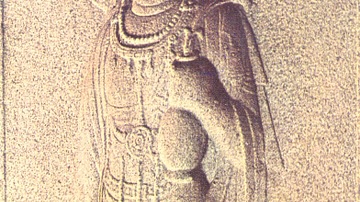
Avalokitesvara, Seokguram Grotto
A granite relief sculpture of Avalokitesvara, the eleven-headed bodhisattva. The Seokguram Grotto, near Gyeongju, Korea. Height: over 2 metres. Unified Silla Period, 8th century CE.

Definition
Foot-Binding
Foot-binding was a practice first carried out on young girls in Tang Dynasty China to restrict their normal growth and make their feet as small as possible. Considered an attractive quality, the effects of foot-binding were painful and permanent...
