
Search
Remove Ads
Advertisement
Search Results

Definition
Kami
In the Shinto religion kami is an all-embracing term which signifies gods, spirits, deified mortals, ancestors, natural phenomena, and supernatural powers. All of these kami can influence people's everyday lives and so they are worshipped...
Definition
Hilda of Whitby
Hilda of Whitby (also known as Saint Hilda of Whitby, l. 614-680 CE) was the founder and abbess of the monastery at Whitby, Kingdom of Northumbria, Britain. She was a Northumbrian princess who converted to Christianity with the rest of the...

Definition
Epaminondas
Epaminondas (or Epameinondas, c. 420 - 362 BCE) was a Theban general who famously defeated Sparta at the Battle of Leuctra in 371 BCE. The daring and brilliant pre-meditated tactics of Epaminondas earned a decisive victory over Sparta and...

Article
The Home Fronts in World War I - The Effects of Total War on Civilians
The First World War (1914-18) saw fighting on an unprecedented scale but also involved civilians as never before. For the first time, people hundreds of miles from the fighting front were vulnerable to air attacks. The war at sea dramatically...

Article
Women Scientists in the Scientific Revolution
Women scientists during the Scientific Revolution (1500-1700) were few in number because male-dominated educational institutions, as well as scientific societies and academies, barred women entry, meaning that few had the education or opportunity...

Article
Battle of Jena-Auerstedt
The twin battles of Jena and Auerstedt, both fought on 14 October 1806, marked a major turning point in the Napoleonic Wars (1803-1815). It saw the French Grande Armée, led by Emperor Napoleon I (r. 1804-1814; 1815) soundly defeat the Prussian...

Article
The Causes of WWI
The origins of the First World War (1914-18) are many and varied, with some even dating back several decades, but a political assassination in the Balkans in the summer of 1914 was the spark that blew up Europe's political powder keg, that...

Article
Italian Colonialism in Eritrea
Eritrea, located on the Red Sea coast of the Horn of Africa, was the ‘firstborn’ colony of Italy. The potential of a trade centre and naval base at Assab first attracted Italian interests in 1869. The Kingdom of Italy, however, did not officially...

Article
Why Did Britain & France Appease Hitler?
The policy of appeasement towards the demands of Adolf Hitler (1889-1945) regarding Nazi Germany's territorial expansion ultimately failed when the Second World War (1939-45) began. The reasons appeasement was adopted by Britain and France...
Article
The Forty-Two Judges
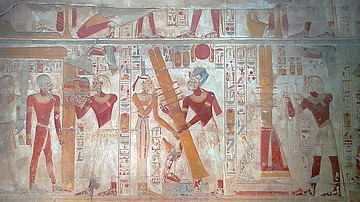
The Forty-Two Judges were divine entities associated with the afterlife in ancient Egypt and, specifically, the judgment of the soul in the Hall of Truth. The soul would recite the Negative Confession in their presence as well as other gods...
