
Search
Remove Ads
Advertisement
Search Results

Video
The Early History of the Parthenon, Acropolis and Agora of Ancient Athens
The early history of the Parthenon, the Acropolis and the Agora of Ancient Athens is a rich one, with numerous periods of building and construction. The term Agora in Greek means an...

Definition
Athens
Athens, Greece, with its famous Acropolis, has come to symbolize the whole of the country in the popular imagination, and not without cause. It not only has its iconic ruins and the famous port of Piraeus but, thanks to ancient writers...

Definition
Gaia
Gaia (also Gaea or Ge) is a primordial goddess and the personification of the Earth in Greek mythology. Gaia emerged from Chaos and is considered the supreme or mother goddess by immortals and mortals alike. All gods and goddesses are...
Definition
Perseus
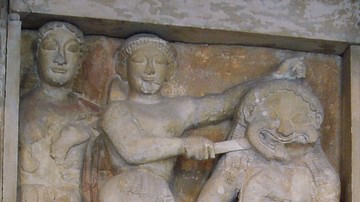
Perseus is one of the greatest and oldest pan-Hellenic heroes of Greek mythology. Perseus famously killed the dreaded Medusa, a Gorgon with snakes as hair and whose stare turned men to stone. Perseus also carried out the daring rescue...
Definition
Giants
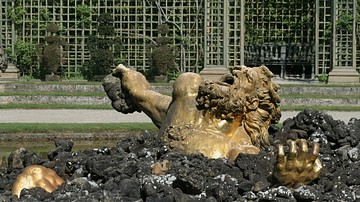
In Greek mythology, the Giants (Gigantes) are an aggressive race of creatures who were born from Gaia (the Earth) after drops of Uranus' blood fell on the Earth after he was castrated. The Giants had great strength and were fearsome to...

Definition
Library of Pergamon
The Library of Pergamon was established in the city of Pergamon (also Pergamum) by the Attalid King Eumenes II (r. 197-159 BCE) and became the most famous and well-respected center of learning after the Library at Alexandria...

Video
Great Altar of Zeus and Athena at Pergamon
The Pergamon Altar, c. 200-150 BCE, 35.64 x 33.4 meters, Hellenistic Period (Pergamon Museum, Berlin).
Speakers: Dr. Steven Zucker and Dr. Beth Harris.
Created by Beth Harris and Steven Zucker.

Definition
Agora
The term agora (pronounced ah-go-RAH) is Greek for 'open place of assembly' and, early in the history of Greece, designated the area in a city where free-born citizens could gather to hear civic announcements, muster for military campaigns...

Definition
Minerva
Minerva was the Roman goddess of wisdom, medicine, commerce, handicrafts, poetry, the arts in general, and later, war. In many ways similar to the Greek goddess Athena, she had important temples in Rome and was patron of the Quinquatras...

Definition
Calypso - The Nymph Who Kept Odysseus Prisoner
In Greek mythology, Calypso, whose name means "to hide" or "to conceal," is a nymph best known from Homer's (c.750 BCE) epic The Odyssey for falling in love with Odysseus and imprisoning him on her island...
