
Search
Did you mean: Anu?
Search Results
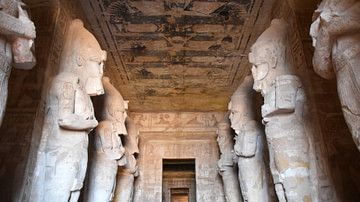
Image
Abu Simbel, Interior of the Temple of Ramesses II
The hypostyle hall of the Temple of Ramesses II at Abu Simbel is 18 m (59 ft) long and 16.7 m (55 ft) wide and is supported by eight massive pillars depicting the deified Ramesses linked to the god Osiris. The temple's interior is decorated...

Image
Abu Simbel - Work in Progess
View of work in progress, during the repositioning of the temples of Abu Simbel, relocated 60 meters high and 200 meters back from its original position
Image
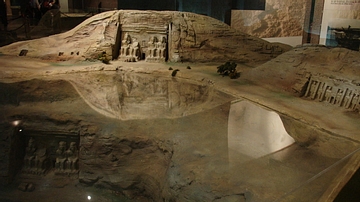
Abu Simbel - Plastic
Final plastic, which shows the original position of the temples of Abu Simbel (1300 BC) and the final position after the grand relocation.

Image
Abu Simbel, Interior of the Temple of Hathor
The Temple of Hathor or "Small Temple" was constructed during the reign of Ramesses II (c. 1279 - c. 1213 BCE). It was dedicated to the goddess Hathor and Queen Nefertari, Ramesses' favourite wife. The temple's hypostyle hall is supported...
Image
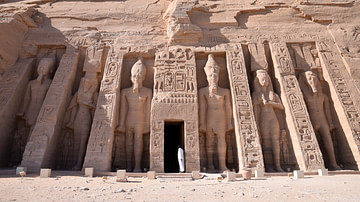
Abu Simbel, Facade of the Temple of Hathor
The Temple of Hathor or "Small Temple" was constructed during the reign of Ramesses II (c. 1279 - c. 1213 BCE). The Small Temple was dedicated to the goddess Hathor and Queen Nefertari, Ramesses' favourite wife. On the facade, six colossi...
Image
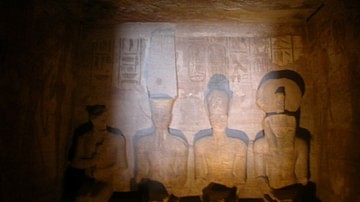
Abu Simbel Interior
Inside the Great Temple The architects of ancient Egypt in the 13th century BCE aligned the temple so that , on October 21 and February 21 (61 days before and 61 days after the winter solstice), the sun’s rays enter into the sanctuary...

Image
Abu Simbel, Facade of the Temple of Ramesses II
The Great Temple at Abu Simbel was built by Ramesses II and completed around 1264 BCE. It stands 98 feet (30 metres) high and 115 feet (35 metres) long with four seated colossi flanking the entrance, two to each side, depicting Ramesses II...

Definition
Fatimah bint Muhammad
Fatimah (born between 605 and 615 CE, died sometime in 632 CE; date of death is disputed) was the youngest daughter of the Islamic Prophet Muhammad (l. 570-632 CE) and his first wife Khadija (l. 555-619 CE). Taking up after her father, Fatimah...

Video
Abu Mena (UNESCO/NHK)
The church, baptistry, basilicas, public buildings, streets, monasteries, houses and workshops in this early Christian holy city in Egypt were built over the tomb of the martyr Menas of Alexandria, who died in A.D. 296. Source: UNESCO...
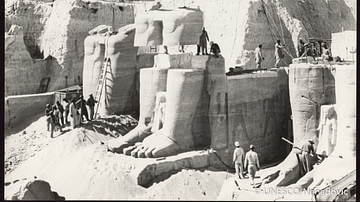
Image
Dismantling of Abu Simbel Statues, 1966
Dismantling of the statues of the Great Temple at Abu Simbel during the International Campaign for the Safeguard of the Nubian Monuments launched by UNESCO.
Abu Simbel, Egypt, Nubia (9 February 1966)
