
Search
Remove Ads
Advertisement
Search Results
Image
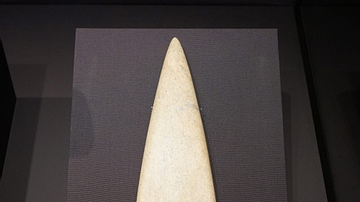
Stone Age Jade Axe
Jade, 5000-3600 BCE. Biebrich, Germany. This axe is made of European jade mined in prehistoric quarries in the Italian Alps. It appears to be an object of beauty rather than function. It would have taken several days to...
Image
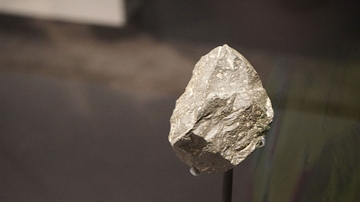
Olduvai Stone Chopping Tool
Stone chopping tool. 1.8 - 2 million years old. Found in Olduvai Gorge, Tanzania. This chopping tool is an example of the oldest known objects deliberately made by humans. This tool was found with the fossil remains...

Image
Champollion's notes from the Rosetta Stone
This is a copy of the Rosetta Stone with some hand notes made by Jean-François Champollion.
This photo was taken at the Neues Museum, Berlim.
Image
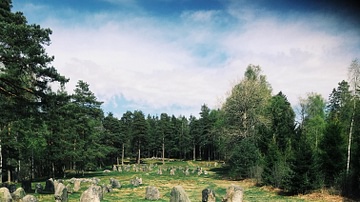
Stone Circles at The Hunnfelt
View of the nine stone circles at The Hunnfelt in Østfold, Norway. Dating from c. 500 BCE to c. 900 CE.

Image
Powhatan Stone
The Powhatan Stone, a historical marker erected by the Association for the Preservation of Virginia Antiquities in Chimborazo Park, Richmond, Virginia, USA. It was placed by the Mayo family of Richmond who once owned the property...

Definition
Maeshowe - The Ancient Meadow Mound of Orkney
Maeshowe (pronounced `maze-ow' or `maze-oo') is a large Neolithic chambered cairn, dating from between 3000-2800 BCE, in the Stenness parish of Orkney, Scotland. According to Dr. Berit Sandnes, of Lund University...

Definition
Aztec Civilization - The Last Mesoamerican Empire
The Aztec Empire (c. 1345-1521) covered at its greatest extent most of northern Mesoamerica. Aztec warriors were able to dominate their neighbouring states and permit rulers such as Montezuma to impose...

Definition
Etruscan Architecture
The architecture of the Etruscan civilization, which flourished in central Italy from the 8th to 3rd century BCE, has largely been obliterated both by the conquering Romans and time, but the very influence of the Etruscans...

Image
The Snaptun Stone
The Viking Age Snaptun stone was carved around 1000 CE and shows a face with stitched-up lips, which reminds of a story preserved in the Prose Edda where the Norse god's Loki’s lips are sewn up. As such, it is usually thought...
Image
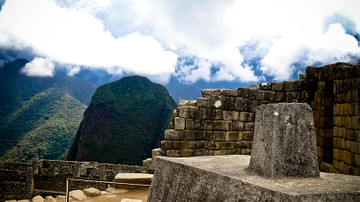
Intihuatana Stone, Machu Picchu
The Intihuatana Stone or 'Hitching Post of the Sun' at Machu Picchu in the High Andes. The stone was used by Inca priests for astronomical observations, especially of the sun. In ceremonies during the solstices the...
