
Search
Remove Ads
Advertisement
Search Results

Article
The Telescope & the Scientific Revolution
The invention of the telescope in 1608 is usually credited to the Dutchman Hans Lippershey. The astronomical telescope became one of the most important of all instruments during the Scientific Revolution when figures like Galileo (1564-1642...

Article
Observatories in the Scientific Revolution
The foundation of observatories during the Scientific Revolution (1500-1700) followed a process of evolution from entirely independent observatories operated by a single astronomer to private observatories which received state or private...

Article
Astronomy in the Scientific Revolution
The astronomers of the Scientific Revolution rejected long-held theories of ancient thinkers like Claudius Ptolemy and Aristotle and instead set out to systematically observe the heavens in order to create a model of the universe that fit...
Image
Eyepiece of Galileo's Telescope
The eyepiece of a model of the telescope made by Galileo (1564-1642) c. 1608. Galileo made a telescope capable of x33 magnification and used it to make several important discoveries in astronomy. 970 mm x 60 mm. (Science Museum, London)

Definition
Galileo Galilei
Galileo Galilei (1564-1642) was an Italian mathematician, physicist, astronomer, and natural philosopher. He created a superior telescope with which he made new observations of the night sky, notably that the surface of the Moon has mountains...
Image
Galileo Demonstrating His Telescope
A c. 1900 painting by Henry-Julien Detouche showing Galileo (1564-1642) demonstrating his telescope (which he built c. 1608) to Leonardo Donato, Doge of Venice

Image
Newton's Reflecting Telescope
A replica of the reflecting telescope invented and designed by Isaac Newton (1642-1727) in 1668. 160 mm x 275 mm x 295 mm. (Science Museum, London)
Image
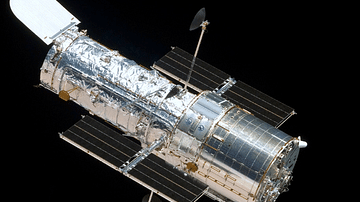
The Hubble Space Telescope
The Hubble Space Telescope which was launched into space by NASA in 1990.
Image
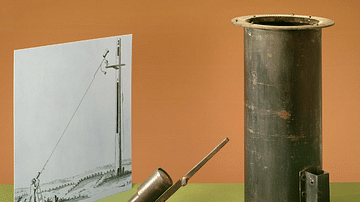
Huygen's Aerial Telescope
The eyepiece, main lens housing, and a drawing illustrating the aerial telescope designed and built by the Dutch mathematician and astronomer Christiaan Huygens (1629-1695) towards the end of the 17th century. (Science Museum, London)
Image
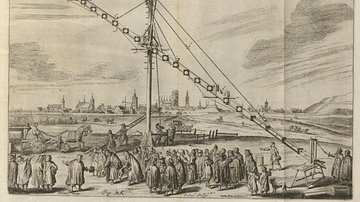
Hevelius' Astronomical Telescope
A print showing one of the astronomical telescopes built by Johannes Hevelius (1611-1687) in Danzig in the 1640s. Helevius used such devices to map the surface of the Moon. (Harvard University)
