
Search
Did you mean: Qanat?
Remove Ads
Advertisement
Search Results

Definition
Thugga
Thugga (also Dougga) was a town in North Africa which was first a Numidian and then a Carthaginian settlement before being incorporated into the Roman Empire. The town was built on a strategically favourable limestone hilltop overlooking...

Image
Carthaginian Silver Tetradrachm
A silver tetradrachm minted in Carthage, 330-300 BCE. Obv.: head of the goddess Tanit with dolphins. Rev. : horse's head and palm tree. The legend reads 'm mhnt' meaning 'people of the camp', that is army camp. Many such coins were minted...

Definition
Neith
Neith (aka Net, Neit or Nit) and is one of the oldest deities of ancient Egypt who was worshipped early in the Pre-Dynastic Period (c. 6000 - 3150 BCE) and whose veneration continued through the Ptolemaic Dynasty (323 - 30 BCE), the last...

Definition
Juno
Juno was the Roman goddess who protected the nation as a whole but also kept special watch over all aspects of women's lives. She is often thought of as the Roman version of the Greek goddess of love and marriage, Hera. Juno was the wife...

Definition
Phoenician Architecture
Phoenician architecture is typified by large temples with double-columned facades approached by a short staircase, enclosed sacred spaces containing cube-like and open-fronted shrines, and such large-scale engineering projects as dams and...

Definition
Crafts
The word 'Craft' comes from the Middle English word for 'strength' or 'skill' derived from the Old English word craeft which comes from Old High German kraft, for strength, and means “skill in planning, making, executing” and, by extension...

Definition
Carthaginian Warfare
Carthaginian warfare has been overshadowed by defeat to Rome in the Punic Wars, but for six centuries before that Carthage was remarkably successful in conquering lucrative territories in North Africa, the Iberian Peninsula, and Sicily. By...
Definition
Carthaginian Coinage
The coinage of Carthage was first minted from the 5th century BCE. Initially adopting the drachma, the Carthaginians later minted silver shekel coins. Designs were instantly recognisable, as intended, and included famous figures such as Hannibal...
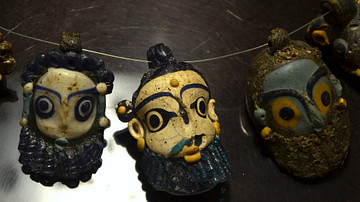
Article
Carthaginian Society
The society of Carthage was dominated by an aristocratic trading class who held all of the important political and religious positions, but below this strata was a cosmopolitan mix of artisans, labourers, mercenaries, slaves, and foreigners...

Article
Hanno: Carthaginian Explorer
In the 5th century BCE, the Carthaginian explorer Hanno sailed beyond the Pillars of Hercules, out of the Mediterranean and into hitherto unknown territory down the Atlantic coast of Africa. In his search to find new resources and trading...
