
Search
Did you mean: Satyr?
Remove Ads
Advertisement
Search Results

Definition
Titan - The Gods Defeated by the Greek Olympians
In Greek mythology the terrible and powerful Titans were those deities which preceded the Olympian gods. Never worshipped as the other gods, they nevertheless helped, through contrast, to clarify the position...

Definition
Cassander
Cassander (c. 355-297 BCE, r. 305-297 BCE) was self-proclaimed king of Macedon during the political turmoil following Alexander's death. Born in Greece as the son of Antipater, the regent of Macedon and Greece in the absence of Alexander...

Definition
Ghosts in the Ancient World - The Return of the So-Called Dead
A belief in an afterlife was central to every major civilization of the ancient world and this encouraged the recognition of the reality of ghosts as the spirits of the departed who, for one...

Article
The Ancient Concept of a Noble Death
The act of voluntary death was never condemned in antiquity. In fact, The English word "suicide" comes from the Latin for "self-slaying." The reason for a voluntary death had to be one that was honorable and necessary...

Article
The Value of Family in Ancient Greek Literature
When looking at Ancient Greek literature, one can see the importance family plays in Greek culture. We see this displayed in the Greek works Medea by Euripides and Antigone by Sophocles. Throughout these...

Image
The Titan Oceanus
A representation of the Titan Oceanus, a figure from Greek mythology who was a personification of the river or ocean which encircled the world and was the source of all other rivers. With the Titan Tethys, he was the father of...
Image
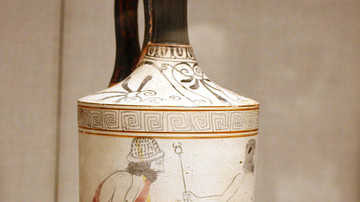
Attic Lekythos
An Attic lekythos vase, c. 450 BCE. This type of vessel was used for storing fine oils and perfume and often dedicated in burials. Here, Charon is depicted, the boatman who ferried souls across the river Styx to Hades. To the right...

Image
Charon, Attic Lekythos Detail
A detail of an Attic lekythos vase, c. 450 BCE showing Charon, the boatman who ferried souls across the river Styx to Hades. To the right is Hermes, identified by his kerykeion or herald's staff and fulfilling one of...

Image
Titan
A representation of the Titan Oceanus, a figure from Greek mythology who was a personification of the river or ocean which encircled the world and was the source of all other rivers. With the Titan Tethys, he was the father of the Oceanids...
Image
Roman Skull with Obol in Mouth
Upon death, ancient Greek culture called for placing a coin, or obol, in the mouth of the deceased to pay Charon for rowing him/her across the River Styx to the afterlife.
