
Search
Did you mean: Thugga?
Remove Ads
Advertisement
Search Results
Image
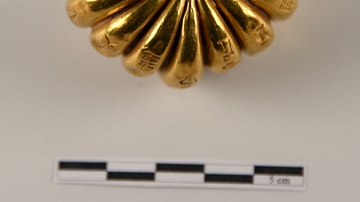
A Gold Earring from Ur III
This is the lower surface of the earring. The cuneiform text is read vertically, from the upper surface downwards on each segment, and it continues from right to left. One of a pair of gold earrings, 24 carats. Gift from...
Image
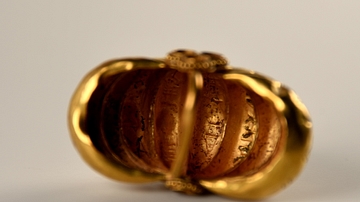
Interior Cuneiform of Gold Earring, Ur III
The interior hollow surface of the earring. Note how the carved cuneiform signs appear on this side and how the goldsmith joined the “lunar-shaped” segments of the earring. One of a pair of gold earrings...
Image
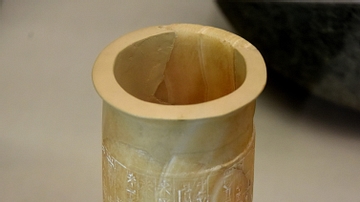
Cylindrical Calcite Jar from Ur
This jar was dedicated to Shulgi, king of Ur III dynasty, by the priestess Shuqurtum. There are two incised channels at the upper half; between them, the cuneiform inscription was placed. The inscription also curses...

Article
Ten Ancient Mesopotamia Facts You Need to Know - Fun Facts on the Cradle of Civilization
Mesopotamia is the ancient Greek name (meaning "the land between two rivers," the Tigris and Euphrates) for the region corresponding to modern-day Iraq and parts of Iran...

Article
12 Great Cities of Ancient Mesopotamia - The Rise and Fall of the Earliest Cities in the World
The great cities of Mesopotamia ("the land between two rivers") developed prior to the late 4th millennium BCE along two rivers – the Tigris and Euphrates – and were...

Article
Kesh Temple Hymn - The Oldest Work of Religious Literature in the World
The Kesh Temple Hymn (circa 2600 BCE) is the oldest work of religious literature in the world, sometimes referenced as the oldest extant religious poem. It is a Sumerian praise song...

Article
Sargon and Ur-Zababa - Two Dream Visions and a River of Blood
Sargon and Ur-Zababa is a Sumerian poem, date of composition unknown, relating the rise to power of Sargon of Akkad (reign 2334-2279 BCE), founder of the Akkadian Empire. The work is classified...

Image
Curator with Pair of Gold Earrings from Ur III
A curator is doing a routine and regular preservation work on a pair of gold earrings at the lab of the Sulaymaniyah Museum of Iraqi Kurdistan. October 18, 2017; exclusive photo. Ur III Period, reign of...

Image
A Stone Bowl with Two Inscriptions
This stone bowl has two sets of cuneiform inscriptions. The first one says that the bowl was booty brought to Mesopotamia from Magan (modern Sultanate of Oman) by the Akkadian king Naram-Sin (2254-2218 BCE). The...

Definition
Gilgamesh
Gilgamesh is the semi-mythic King of Uruk best known as the hero of The Epic of Gilgamesh (c. 2150-1400 BCE) the great Babylonian poem that predates Homer's Iliad and Odyssey by 1500 years and, therefore, stands as the oldest piece...
