
Search
Did you mean: Senusret III?
Remove Ads
Advertisement
Search Results

Article
Queen Hatshepsut: Daughter of Amun, Pharaoh of Egypt
Hatshepsut, whose name means "Foremost of Noble Women" or "First Among Noble Women" (royal name, Ma'at-ka-re, translated as "spirit of harmony and truth") was the fifth ruler of the 18th Dynasty (r...

Article
Ancient Egyptian Taxes & the Cattle Count
The gods of ancient Egypt freely gave their bounty to the people who worked the land, but this did not exempt those farmers from paying taxes on that bounty to the government. Egypt was a cashless society until...
Article
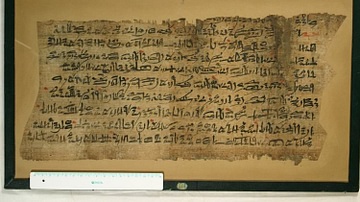
The Papyrus Lansing: Be A Scribe…Or Else!
The Papyrus Lansing is an ancient Egyptian document that dates to the reign of the Pharaoh Senusret III (also known as Sesostris III, and, arguably, the legendary Sesostris written of by Herodotus) the 5th...

Article
Interrelations of Kerma and Pharaonic Egypt
The vacillating nature of Ancient Egypt's associations with the Kingdom of Kerma may be described as one of expansion and contraction; a virtual tug-of-war between rival cultures. Structural changes in Egypt's...
Image
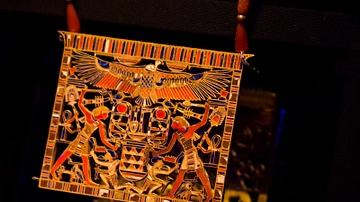
Pectoral of Mereret
Dahshur Pyramid Complex of Senwosret III, Tomb of Mereret
Middle Kingdom of Egypt, 12th Dynasty
Image
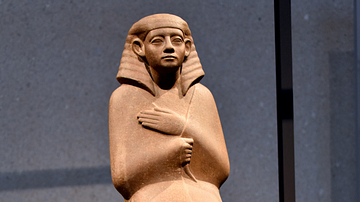
Block Statue of Nemti-hotep
Seated figure of the Egyptian steward Nemti-hotep. Quartzite. From Asyut, Egypt. Middle Kingdom, 12th Dynasty, reign of Senusret III, 1872-1853 BCE. It is on display at the Neues Museum, Berlin, Germany.

Image
White Chapel
The White Chapel, a structure significant to archaeologists and scholars for listing all the nomes of the time on it, built by Senusret I, 1971-1926 BCE, Middle Kingdom of Egypt. The White Chapel was destroyed and recycled for use...
