
Search
Remove Ads
Advertisement
Search Results

Article
Women in the American Revolution
In Colonial America, women were discouraged from taking an interest in politics and were instead expected to focus only on traditionally 'feminine' matters, such as homemaking and childrearing. However, such gender...
Article
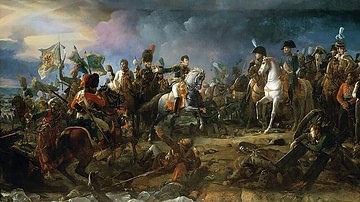
Battle of Austerlitz
The Battle of Austerlitz (2 December 1805), or the Battle of the Three Emperors, was one of the most significant battles of the Napoleonic Wars (1803-1815). It saw French Emperor Napoleon I (r. 1804-1814; 1815) and his Grande...

Definition
First Agricultural Revolution
The First Agricultural Revolution, beginning c. 12-20,000 years ago, was characterized by the emergence of different agricultural systems in different parts of the world, whose common trait was the use of native species...

Article
The Microscope & the Scientific Revolution
The microscope was one of the most significant inventions of the Scientific Revolution, opening up completely new and miniaturised worlds. The first microscopes were invented in the first quarter of the 17th...

Article
Observatories in the Scientific Revolution
The foundation of observatories during the Scientific Revolution (1500-1700) followed a process of evolution from entirely independent observatories operated by a single astronomer to private observatories...

Definition
Peter the Great
Peter I of Russia (Peter the Great) was the Tsar of Russia from 1682-1721 and Emperor of Russia from 1721-1725. During his long reign, Peter had absolute power and brought real change to Russia, including building its first navy...
Collection
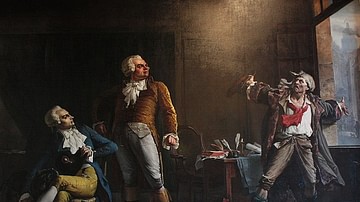
17 Key Figures of the French Revolution
The French Revolution (1789-1799) was one of the defining events of Western history. Triggered by economic troubles, political turmoil, and social inequality, the Revolution saw the French people topple their...

Article
Trade Unions in the British Industrial Revolution
Trade unions were formed in Britain during the Industrial Revolution (1760-1840) to protect workers from unnecessary risks using dangerous machines, unhealthy working conditions, and excessive hours...

Article
The Railways in the British Industrial Revolution
The railways were perhaps the most visible element of the Industrial Revolution for many. Trains powered by steam engines carried goods and people faster than ever before and reached new destinations...

Article
The Steel Industry in the British Industrial Revolution
The production of steel during the British Industrial Revolution became cheaper and more reliable thanks to the Bessemer converter, a type of blast furnace that removed undesirable impurities from...
