
Search
Remove Ads
Advertisement
Search Results

Definition
Silenus
Silenus (also spelt Silenos) is a rustic god of the forest, drunkenness and wine-making in Greek mythology. He is best known as the companion and foster father of the god Dionysos. Silenus is closely associated with the satyrs, sometimes...

Article
A Visual Who's Who of Greek Mythology
Achilles The hero of the Trojan War, leader of the Myrmidons, slayer of Hector and Greece's greatest warrior, who sadly came unstuck when Paris sent a flying arrow guided by Apollo, which caught him in his...

Image
Odysseus blinding the Cyclops
Attic black-figure skyphos depicting Odysseus blinding the sleeping Cyclops Polyphemus, by the Theseus Painter, from Boeotia (Greece), 490-480 BCE. (Altes Museum, Berlin)

Definition
Homer
Homer (c. 750 BCE) is perhaps the greatest of all epic poets and his legendary status was well established by the time of Classical Athens. He composed (not wrote, since the poems were created and transmitted orally, they were not written...

Definition
Literature - The Artistic Expression of the Human Experience
Literature (from the Latin Littera meaning "letters" and referring to an acquaintance with the written word) is the written work of a specific culture, sub-culture, religion, philosophy, or the...

Definition
Neptune
Neptune is the Roman god of the sea and the Roman equivalent of the Greek god Poseidon. He was originally a god of fresh water and became associated with Poseidon early on in Roman history. He lives in a golden palace at the bottom of...
Definition
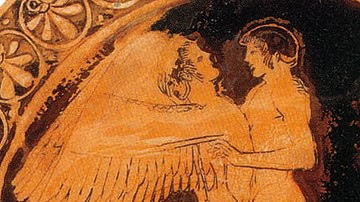
Zephyrus
Zephyrus was the god of the west wind and the messenger of spring in Greek mythology. He was known as one of the four Anemoi, or wind gods, each of whom represented a cardinal direction and, except for Eurus, a season. Zephyrus was...

Image
Odysseus
Roman statuette of the Greek hero Odysseus, 2nd century CE. He holds a cup of wine in offering to the Cyclops Polyphemus. By getting him drunk, the hero was able to blind Polyphemus and escape from the Cyclops' cave to continue his...

Article
The Invention of the First Coinage in Ancient Lydia
Money may take many forms, from the digital code of cryptocurrency to the woodpecker scalps favoured in early California. People have also used cattle, cacao beans, cowrie shells, chewing gum, grain...

Article
Nero's Golden House (Domus Aurea)
Nero's Golden House (the Domus Aurea) in Rome was a sumptuous palace complex which played host to the wild parties of one of Rome's most notorious emperors. Besides using the finest marble and decoration such as...
