
Search
Did you mean: Miltiades?
Remove Ads
Advertisement
Search Results

Definition
Machu Picchu
Machu Picchu is an Inca settlement located in the High Andes of Peru in the Urubamba Valley, north of Cuzco. The site, perched high above the Urubamba river, has been variously described as a fortress, imperial retreat and ceremonial precinct...
Definition
Diana
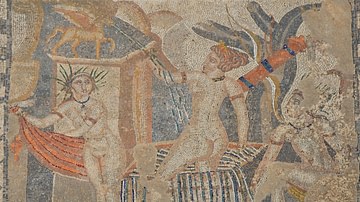
Diana was the goddess of childbirth, the fertility goddess, the goddess of the moon as well as the patron goddess of wild beasts in Roman mythology. However, she is best known as the goddess of the hunt, with her sacred animal being the deer...

Definition
Agni
Agni is the Hindu god of fire. He is regarded as the friend and protector of humanity, in particular, he safeguards the home. Various forms of fire are associated with Agni and include the sun, lightning, comets, sacrificial fire, domestic...
Definition
Xiuhtecuhtli - The Aztec God of Fire
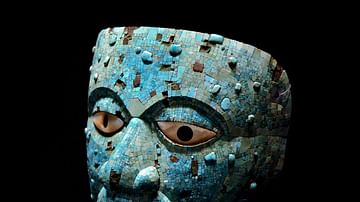
Xiuhtecuhtli or 'Turquoise Lord' was the Aztec god of fire and also closely associated with young warriors and rulers. To the Maya he was known as Chac Xiutei. Xiuhtecuhtli was the patron of the day Atl (water) and the trecena period 1 Coatl...

Article
The Mesopotamian Pantheon - The Ancient Gods and Goddesses of the Near East
The gods of the Mesopotamian region were not uniform in name, power, provenance or status in the hierarchy. Mesopotamian culture varied from region to region and, because of this, Marduk should not be regarded as King of the Gods in the same...

Article
Aztec Pantheon
The gods of the Aztecs (1345-1521 CE) were many and varied and, as with many other ancient cultures, deities were closely associated with things and events important to the culture and the general welfare of the community. These include gods...

Article
Harappa: An Overview of Harappan Architecture & Town Planning
Harappa is a large village presently in the province of Punjab in Pakistan. The modern town is a part of and lies next to the ancient city. The site of Harappa is important in that it has provided proof of not just the Indus Valley Civilization...
Article
The Aztec New Fire Ceremony
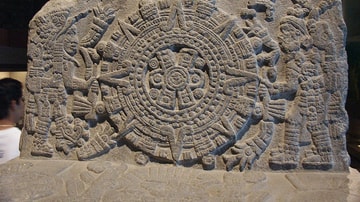
The New Fire Ceremony, also known as the Binding of the Years Ceremony, was a ritual held every 52 years in the month of November on the completion of a full cycle of the Aztec solar year (xiuhmopilli). The purpose of it was none other than...

Article
The Athenian Calendar
The term “Athenian Calendar” (also called the “Attic Calendar”) has become somewhat of a misnomer, since Ancient Athenians never really used just one method to reckon the passage of time. Athenians, especially from the 3rd Century BCE forward...
Article
The Nazca Lines: A Life's Work
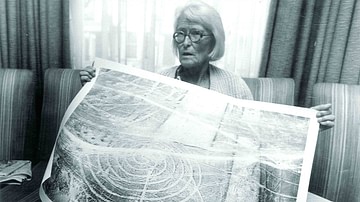
The World Heritage-listed Nazca lines are a well-known part of the ancient heritage of Peru. One woman spent over 50 years studying and protecting them. Ana Maria Cogorno Mendoza shares the story of Dr Maria Reiche. The lines and geoglyphs...
