
Search
Remove Ads
Advertisement
Search Results

Definition
Portuguese Nagasaki
Nagasaki, on the northwest coast of Japan’s Kyushu Island, was an important Portuguese trading base from c. 1571 to 1639, and the most eastern outpost of the Portuguese empire. The Portuguese presence transformed Nagasaki from a small fishing...
Image
Portuguese Ship at Nagasaki
A detail from a Japanese painted screen showing a Portuguese carrack at the port of Nagasaki, a Portuguese trading post from c. 1571 to 1639. Screen painted by Kanō Naizen. (Kobe City Museum, Japan)
Image
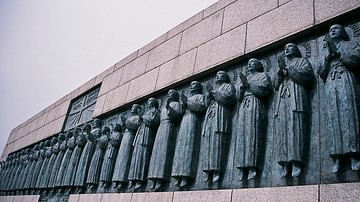
Memorial of the 26 Martyrs of Japan in Nagasaki
Memorial of the 26 Martyrs of Japan in Nagasaki, who were executed for their Christian beliefs in 1597, after Japan had outlawed the religion. Canonised by the Catholic Church, the martyrs were tortured before their execution, with the event...

Definition
Boeing B-29 Superfortress
The Boeing B-29 Superfortress was a four-engined, long-range bomber of the United States Air Force. The largest of all Second World War (1939-45) bombers, B-29s were used to strike Japanese targets from the summer of 1944. In August 1945...

Definition
Portuguese Empire
The Portuguese Empire was established from the 15th century and eventually stretched from the Americas to Japan. Very often a string of coastal trading centres with defensive fortifications, there were larger territorial colonies like Brazil...

Definition
Estado da India
The Estado da India (1505-1961) was the name the Portuguese gave to that part of their empire which stretched from India to East Asia. However, in its widest sense, the name includes all Portuguese colonies east of the Cape of Good Hope and...

Definition
Potsdam Conference - When the WWII Allies Declared Japan Must Surrender
The Potsdam Conference, held from 17 July to 2 August 1945 in Potsdam in eastern Germany, decided how the Allies would deal with a defeated Germany and how they could best conduct the ongoing campaign against Japan as the Second World War...
Definition
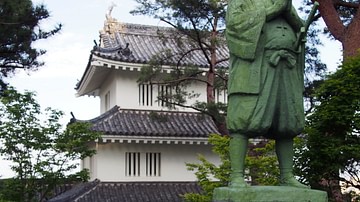
Shimabara Rebellion
The Shimabara Rebellion was a peasant uprising that occurred from 17 December 1637 to 15 April 1638 in Japan's southern island of Kyushu. Economic desperation, famine, and religious persecution led the peasants of the Shimabara peninsular...

Article
Christianity in Japan
Christianity arrived in Japan in 1549 when Jesuits first set foot in Kagoshima. Initial attempts to spread the religion were met with confusion; however, through employing various methods, they began to see success. However, by 1650, Christianity...

Definition
Edo Period
The Edo period refers to the years from 1603 until 1868 when the Tokugawa family ruled Japan. The era is named after the city of Edo, modern-day Tokyo, where the Tokugawa shogunate had its government. It is also sometimes referred to as the...
