
Search
Search Results

Collection
Mesopotamian Gods - A Brief Survey of Some Great Mesopotamian Deities
The gods of Mesopotamia are first evidenced during the Ubaid Period (circa 6500-4000 BCE) when temples were raised to them, but their worship developed during the Uruk Period (circa 4000-3100 BCE) and their names appear in writing beginning...

Definition
Ishtar
Ishtar (Inanna in Sumerian sources) is a primary Mesopotamian goddess closely associated with love and war. This powerful Mesopotamian goddess is the first known deity for which we have written evidence. While largely unknown in the modern...

Definition
Near East
The Near East is a modern-age term for the region formerly known as the Middle East comprising Armenia, Cyprus, Egypt, Iraq, Iran, Israel, Jordan, Lebanon, Palestine, Syria, and part of Turkey, corresponding to ancient Urartu, Mesopotamia...
Collection
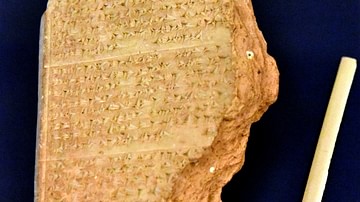
Twelve Stories from the Mesopotamian Scribal School
Sumerian schools (known as edubba, “House of Tablets”) trained the scribes of ancient Mesopotamia in reading, writing, interpretation of texts, general knowledge, and the specifics of whatever field they would eventually work in. The Sumerian...

Definition
Religion in the Ancient World
Religion (from the Latin Religio, meaning 'restraint,' or Relegere, according to Cicero, meaning 'to repeat, to read again,' or, most likely, Religionem, 'to show respect for what is sacred') is an organized system of beliefs and practices...

Article
Trade in Ancient Mesopotamia - How Commerce Encouraged Civilization
Local trade in ancient Mesopotamia began in the Ubaid period (circa 6500-4000 BCE), had developed into long-distance trade by the Uruk period (circa 4000-3100 BCE), and was flourishing by the time of the Early Dynastic period in Mesopotamia...

Definition
Jomon Period
The Jomon Period is the earliest historical era of Japanese history which began around 14500 BCE, coinciding with the Neolithic Period in Europe and Asia, and ended around 300 BCE when the Yayoi Period began. The name Jomon, meaning 'cord...
Image
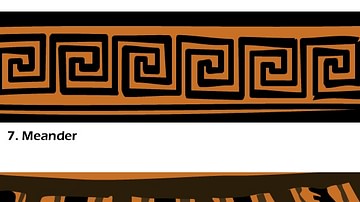
Greek Pottery Ornaments
Ten of the most common decorative ornaments used in ancient Greek pottery. These were used principally on the outer edges of the pottery wares and also on the neck, foot and around handles.

Definition
Bronze Age Aegean
The Bronze Age (c. 3000-1000 BCE) is the period when cultures were either using, producing, or trading bronze. Several cultures flourished around the Aegean Sea during this period: the Minoan civilization on Crete, the Mycenaean civilization...

Definition
Thracian Art
The art produced by the people of Thrace, as indicated by the many precious objects found in Thracian tombs dating from the Bronze Age onwards, was, like the culture itself, a mix of indigenous ideas and foreign influences. Although it can...
