
Search
Remove Ads
Advertisement
Search Results

Article
The Masaesyli and Massylii of Numidia
The North African Berber kingdom of Numidia (202-40 BCE) was originally inhabited by a tribe (or federation of tribes) known as the Masaesyli, to the west, and a coalition of smaller tribes, known as the Massylii...
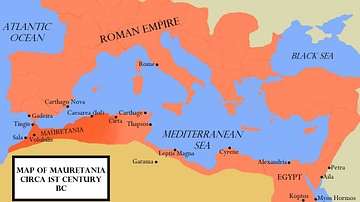
Image
Map of the Kingdom of Mauretania
A map of the Kingdom of Mauretania, circa late 1st Century BCE.
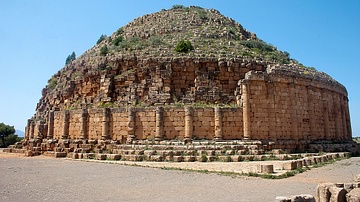
Image
Royal Mausoleum of Mauretania
The Royal Mausoleum of Mauretania in Tipaza, Algeria was built in 3 BCE by Juba II of Numidia (c. 50 BCE – c. 25 CE) and his wife Cleopatra Selene II (40 BCE – c. 5 BCE). This tomb may have been the final resting place...

Image
Royal Mausoleum of Mauretania, Algeria
The Royal Mausoleum of Mauretania near Tipasa in Algeria is a funerary monument built in 3 BCE by Juba II of Numidia (c. 50 BCE- c. 25 CE) and his wife Cleopatra Selene II (40 BCE-c. 5 BCE). This tomb may have...

Image
Triumph of Dionysus Mosaic from Caesarea in Mauretania
The mosaic of the Triumph of Dionysus was found in a private house of Caesarea in Mauretania. The central panel depicts Dionysus holding a thyrsus and riding a chariot drawn by two tigers. It is...

Definition
Caesarea (North Africa)
Caesarea was actually the name of three separate cities: one in Palestine, one in Cappadocia (Asia Minor), and one in Mauretania, present-day Algeria. The first city, Caesarea Maritima, was built by Herod around 25 BCE and...

Image
Roman Empire in 117 CE
Map of the Roman Empire at its maximum extent in 117 CE, under the rule of Trajan.

Definition
Kahina
Kahina (7th century CE) was a Berber (Imazighen) warrior-queen and seer who led her people against the Arab Invasion of North Africa in the 7th century CE. She is also known as al-Kahina, Dihya al-Kahina, Dahlia, Daya, and Dahia-al-Kahina...

Definition
Berbers
The Berbers have occupied North Africa, specifically the Maghreb, since the beginning of recorded history and until the Islamic conquests of the 8th century CE constituted the dominant ethnic group in the Saharan region. Modern Berber...

Definition
RMS Lusitania - Tragic Victim of WWI
RMS Lusitania was a British transatlantic liner infamously sunk by a German U-boat on 7 May 1915 during the First World War (1914-18). Struck off the coast of southern Ireland, the ship sank in less than 20 minutes...
