
Search
Did you mean: Vinland?
Remove Ads
Advertisement
Search Results
Image
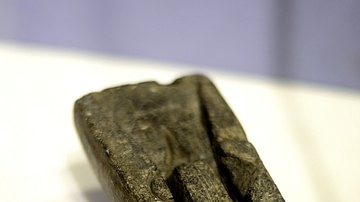
Mould for Palstave Axes from Ancient Ireland
Mould for palstave, a form of early Bronze Age axes, found near Dromore, Co. Down, Ireland, 1500-1000 BCE.
National Museum of Ireland-Archaeology, Dublin.
Image
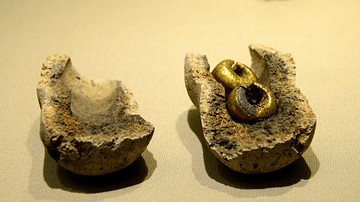
Gold Foil-Covered Lead Bulla from Ancient Ireland
Two small gold foil-covered lead bullae (amulet or pendant), found inside a ceramic vessel, from Annaghbeg or Monasterredan, Co. Sligo, Ireland, c. 800-700 BCE. National Museum of Ireland-Archaeology...

Image Gallery
Scenic Views of Ireland
According to one legend, Ireland takes its name from the Gaelic Eire, derived from Eriu, the daughter of the Mother Goddess Ernmas of the mystical Tuatha De Danaan and, for anyone who has spent any time there, this seems...

Image Gallery
A Gallery of Artifacts of Ancient Ireland
Humans arrived in the region now known as Ireland c. 7000-6500 BCE at modern-day Coleraine in the north, establishing communities and gradually moving southwards. Hunter-gatherers eventually adopted an agrarian...
Image
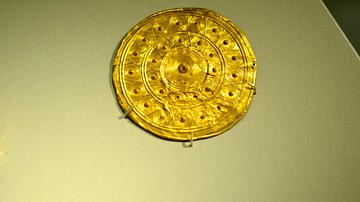
Gold Disc from Ancient Ireland
Gold disc, most likely a terminal of a collar or part of an earspool, from Co. Armagh, Ireland, 800-700 BCE.
National Museum of Ireland-Archaeology, Dublin.

Image
Decorated Stone from Ancient Ireland
Decorated stone from Kilwarden, Co. Kildare, Ireland, 2500-1700 BCE.
National Museum of Ireland-Archaeology, Dublin.

Image
Decorated Bone Objects from Ancient Ireland
Bones decorated with carvings from Loughcrew, Co. Meath, Ireland, 2nd century BCE.
National Museum of Ireland-Archaeology, Dublin.
Image
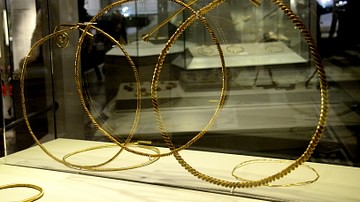
Gold Torcs from Ancient Ireland
Three gold torcs, found at Tipper South, Co. Kildare, Ireland, 1200-1000 BCE.
National Museum of Ireland-Archaeology, Dublin.

Image
Quern & Rubber from Ancient Ireland
Saddle-shaped quern (grindstone) and its rubber, found at Rathgall Hillfort, Rath East, Co. Wicklow, Ireland, 900-500 BCE.
National Museum of Ireland-Archaeology, Dublin.

Image
Glendalough Valley, County Wicklow, Ireland
Glendalough Valley, County Wicklow, Ireland, famous for its natural beauty and the 6th-century monastic community founded by Saint Kevin.
