
Search
Remove Ads
Advertisement
Search Results

Image
Indian Girl in White Blanket
Indian Girl in White Blanket, painting by Robert Henri, 1917.
Corcoran Gallery of Art, Washington D.C.
Photo by Daderot.
Image
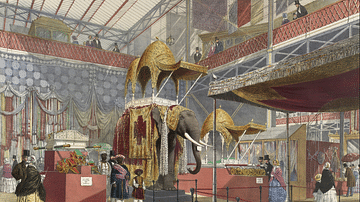
Indian Hall, Great Exhibition
A print of an original watercolour by Joseph Nash showing a section of the Indian Hall in the Crystal Palace of the Great Exhibition of 1851. (British Library, London)
![[The Greatest Chinese Literature] The Dream of the Red Chamber Book I, Part 1 (by Xueqin Cao)](/uploads/kraked/6/6-840_ci_preview.jpg?v=1538483008-1787464462)
Video
[The Greatest Chinese Literature] The Dream of the Red Chamber Book I, Part 1 (by Xueqin Cao)
The main text starts at 1:18 mark. This book is one of the Four Great Classical Novels of China, and considered the greatest of them all. This book is truly epic in...

Video
Shakespeare's Sonnets: Crash Course Literature 304
This week, we're learning about sonnets, and English Literature's best-known purveyor of those fourteen-line paeans, William Shakespeare. We'll look at a few of Willy Shakes's biggest hits, including...
Image
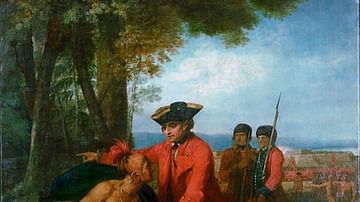
General Johnson Saving a Wounded French Officer From the Tomahawk of a North American Indian
Sir William Johnson saves the life of French General Baron Dieskau after the Battle of Lake George, 1755, oil on canvas painting by Benjamin West, between 1764 and 1768...
Image
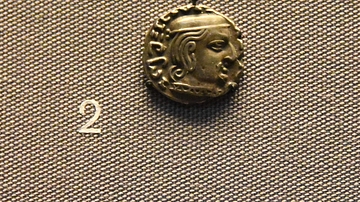
3rd Century CE Indian Coin with Date
In the ancient world, some coins had dates on them. giving us precise information as to when people ruled. These coins are inscribed with dates, so they give fixed points in the chronology of ancient states, to...

Definition
East India Company
The English East India Company (EIC or EEIC), later to become the British East India Company, was founded in 1600 as a trading company. With a massive private army and the backing of the British government, the EIC looted the...

Article
Battle of Hydaspes
For almost a decade, Alexander the Great and his army swept across Western Asia and into Egypt, defeating King Darius III and the Persians at the battles of River Granicus, Issus and Gaugamela. Next, despite the objections of...

Definition
Portuguese Cochin
Cochin, located on the southwest coast of India, was a Portuguese colony from 1503 to 1663. Known to the Portuguese as Cochim, it was one of several important cities on India’s Malabar Coast and a great trade centre for spices...

Article
The Portuguese Conquest of India
Throughout the 15th century, the Portuguese Crown yearned for a piece of the Far Eastern spice trade. For centuries this trade had been dominated by the Venetians who obtained pepper, cloves, nutmeg, ginger and cinnamon...
