
Search

 This answer was generated by
 Search Results

Image
Map of Roman Hispania c. 125 CE
The Roman provinces in Hispania (206 BCE–c. 474 CE) illustrate both the persistence of Roman expansion and the durability of imperial rule. The conquest began in the Second Punic War, when Rome displaced Carthage in 206 BCE, and unfolded...

Article
Education in Roman Spain
There was no compulsory state education for children in any of the western provinces of the Roman Empire. The primary sources are sparse when it comes to the education in Roman Spain, and while some scholars argue for a network of schools...

Definition
Viriathus
Viriathus (c. 180-140 BCE) was the leader of the Lusitani in their war with Rome. In 150 Viriathus escaped the Roman massacre and enslavement of Lusitani who had surrendered peacefully. Viriathus continued to fight in the resistance and rose...

Definition
Magnus Maximus
Magnus Maximus (c. 355 - August 28, 388 CE) was a Roman usurper and Western Roman Emperor from 383-388 CE. He was a prominent general in the Roman army, particularly in the province of Britain. In 383 CE he usurped the Western throne, rebelling...

Article
The Batavian Revolt
Batavian revolt was a rebellion of the Batavians against the Romans in 69-70 CE. After initial successes by their commander Julius Civilis, the Batavians were ultimately defeated by the Roman general Quintus Petillius Cerialis. The year...
Article
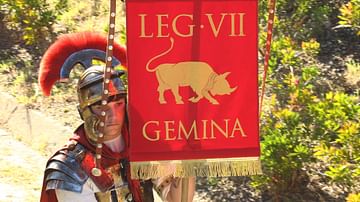
Legions of Spain, Roman Africa & Egypt
The legions of Spain, Roman Africa, and Egypt did not see the intensity of action that prevailed elsewhere in Europe. However, the presence of these four legions - VII Gemina, IX Hispana, XXII Deiotariana, and II Traiana Fortis - was still...

Definition
Vandals
The Vandals were a Germanic tribe who are first mentioned in Roman history in the Natural History of Pliny the Elder (77 CE). The Roman historian Tacitus also mentions them in his Germania (c. 98 CE), though he also refers to them as the...

Definition
Gaiseric
Gaiseric (r. 428-478 CE, also known as Genseric and Geiseric) was the greatest king of the Vandals who remained undefeated from the time he took the throne until his death. He was probably born in 389 CE near Lake Balaton (present-day Hungary...

Article
Legions of the Rhine Frontier
After Julius Caesar’s (100-44 BCE) conquest of Gaul, Roman legions pushed the borders of the Roman Empire’s frontier to the banks of the Rhine River. Augustus (r. 27 BCE - 14 CE) divided the newly acquired region into three provinces: Gallia...

Definition
Visigoth
The Visigoths were the western tribe of the Goths (a Germanic people) who settled west of the Black Sea sometime in the 3rd century CE. According to the scholar Herwig Wolfram, the Roman writer Cassiodorus (c. 485-585 CE) coined the term...
