
Search
Did you mean: Heraclius?
Remove Ads
Advertisement
Search Results

Article
Ten Ancient LGBTQ Facts You Need to Know
Issues in the modern-day regarding gender identity and civil rights for members of the LGBTQ community are a relatively recent phenomenon as are the terms 'homosexual' and 'heterosexual'. In ancient societies...

Article
Truths Wrapped in Fiction: Mesopotamian Naru Literature - Originality in Writing Ancient Bestsellers
Originality in literary compositions in the ancient world did not carry the same weight and value as it does today. In recent centuries, authors have been applauded...

Article
Sicilian Temples (Greek Metrology)
Characteristics of Sicilian Archaic Temples The large dimensions of the components, the presence of a propteron, an adyton, and other specific elements of the plan and elevation speak for an originally very autonomous...

Article
Opening the Way to India
Possibly being overjoyed by the tales of mythical exploits of Heracles, Semiramis, the fabled queen of Assyria, Cyrus, King of Persia and so on, Alexander the Great set out from the tiny kingdom of Macedon for a daring...

Image
The Twelve Olympian Gods of Ancient Greece
The Twelve Olympian Gods (Greek: Δωδεκάθεον, Dodekatheon) represent the core pantheon of ancient Greek religion, embodying divine authority over the natural world, human affairs, and cosmic order. Traditionally...
Image
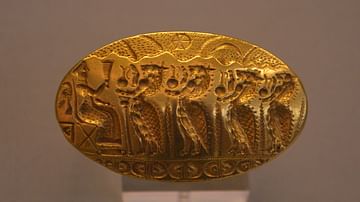
Tiryns Gold Signet Ring
Engraved gold signet ring from Tiryns, c. 15th century BCE. National Archaeological Museum, Athens. The largest ring (7.5 × 3.5 cm) handed down to us from the Mycenaean civilization, the Tiryns signet ring flags up the...

Image
Buddha with Hercules Protector
Heracles depiction of Vajrapani as the protector of the Buddha,
2nd century AD Gandhara, British Museum.

Image
Hercules and Atlas
Metope from the east side of the temple of Zeus, Olympia. Here Hercules (aka Heracles) holds the heavens on his shoulders with the aid of Athena, on the right Atlas gives the Apples of the Hesperides. (470-460 BCE) Olympia Archaeological...
Image
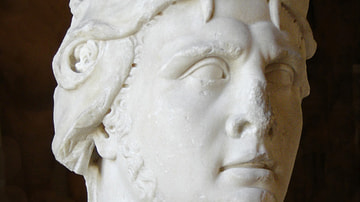
Mithridates VI
Mithridates VI ruled Pontus and Armenia minor 120-63 BCE. Here, he is depicted as Heracles wearing the skin of the Nemean Lion. (Louvre Museum, Paris)
Image
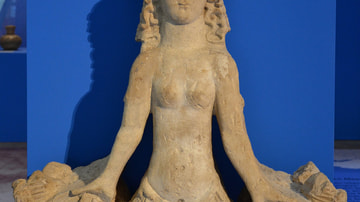
Mixoparthenos
The Mixoparthenos (half-maiden), is a hybrid creature with a double fish-tail from the Black Sea. The limestone sculpture dates back to the 1st-2nd century CE and comes from Panticapaeum in Taurica (Crimea, Ukraine). In Herodotus'...
