
Search
Remove Ads
Advertisement
Search Results
Image
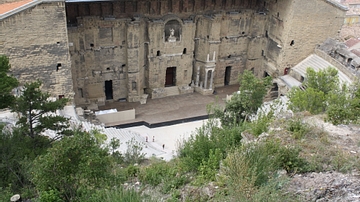
Stage Wall, Theatre of Orange
The stage wall of the 1st century CE Roman theatre at Arausio (Orange, France).

Image
Wall Decorations from the Tomb of Amenhotep II
These two fragments were part of wall decoration of the tomb of the Egyptian pharaoh Amenhotep II. They depict deities (with long curled beard) wearing the crown of Lower Egypt (left) and Upper Egypt (right...

Image
Glazed Wall Tile from Nimrud
This glazed tile once decorated a wall in one of the Assyrian palaces at Nimrud (Kalhu). From Nimrud, in modern-day Iraq. Neo-Assyrian period, 911-609 BCE. (The British Museum, London).
Image
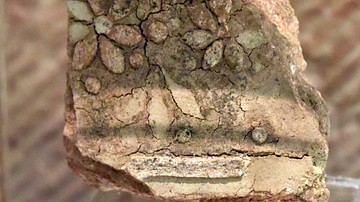
Nabataean Stucco Wall Decoration
Part of a stucco wall decoration from Qasr al-Bint Temple at Raqmu-Petra, Kingdom of Nabataea, 1st century CE.
The Jordan Museum, Amman.

Image
Wall Relief of Ashurnasirpal II from Nimrud
This gypsum wall panel came from the North-West Palace of Ashurnasirpal II (883 - 859 BCE) at Nimrud. Ths so-called "Standard Inscription" of Ashurnasirpal II runs horizontally across the lower part. The...

Image
Wall at the Museo di Torcello
Outside wall of the Museo di Torcello with a collection of different archaeological finds.
Image
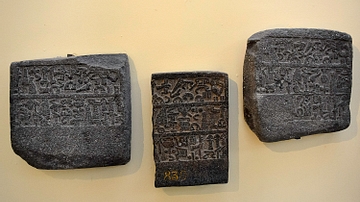
Wall slabs of king Urhilina
The hieroglyphic inscriptions on these basalt wall slabs mention the activities of king Urhilina and his son. From modern-day Hama, Syria. Late Hittite period, 9th century BCE. (Istanbul Archeological Museums/Ancient...
Image
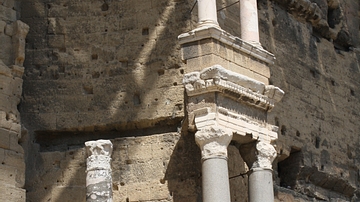
Columns, Orange Theatre Stage Wall Facade
A detail of the facade of the stage wall of the the 1st century CE Roman theatre at Arausio (Orange, France).

Image
Fragment of a Wall Decoration from the Tomb of Seti I
This polychrome hieroglyphic inscription includes parts of the "Litany of the Eyes of Horus". The hieroglyphic signs were painted with vibrant colors and carved in raised relief on a white background...

Image
Bronze Wall-Nail from Urartu
Known as siqqatu (in Akkadian), such nails are found in temples and palaces throughout the Middle East in this period. They were embedded in the walls of rooms and may have been used for wall-hangings. From Toprakkale...
