
Search
Remove Ads
Advertisement
Search Results

Interview
Interview: Super/Natural: Textiles of the Andes
Over the course of several millennia, textiles were the primary form of aesthetic expression and communication for the diverse cultures that developed throughout the desert coasts and mountain highlands of the Andean region. Worn as garments...

Image
Gudrun & Ghost, Laxdale Saga
A scene from the 13th-century Icelandic Laxdæla Saga (anglicised as Laxdale Saga), which is set in the Viking Age (c. 790-1100). Illustration from "Vore fædres liv" : karakterer og skildringer fra sagatiden, collected and published by Nordahl...
Image
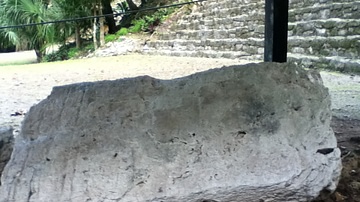
Maya Stele in Grand Plaza Chacchoben, Mexico
Weathered and broken stele in the Grand Plaza of the Maya city of Chacchoben, Mexico, c. 700 CE. It rests at the foot of the stairs leading up to the Gran Basamento plateau where religious rituals were held.
Image
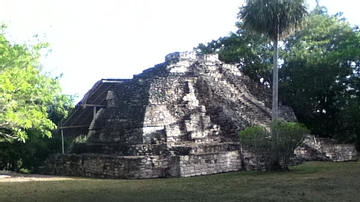
The Temple of the Vessels, Chacchoben
The Temple of the Vessels (Templo de Las Vasijas) at Maya city of Chacchoben, c. 700 CE. Located on the sacred plateau of the Gran Basamento, this temple housed the various goods needed for sacrifice and offerings at the nearby Temple 1.
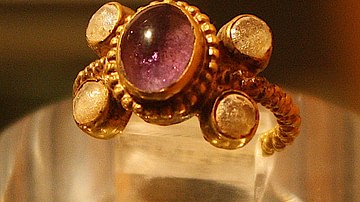
Image Gallery
A Gallery of Bling through the Ages
In this gallery, we showcase 40 precious items that illustrate the love of valuable shiny things that can sparkle up our daily lives is far from being a modern phenomenon. Gold has always been valued for its gleam and incorruptibility, while...

Video
Kabuki: The people's dramatic art - Amanda Mattes
The Japanese dance and theater art of kabuki, derived from the word kabuku, meaning "out of the ordinary," can be traced back to the streets of seventeenth-century Kyoto. Kabuki became a dramatic art for the common people, with its use of...

Image
Map of the Spanish Conquest & Exploration in South America
Spain’s rapid expansion into South America followed the consolidation of its Caribbean footholds by 1512, marking a decisive shift from exploration to imperial conquest. Under the reign of Ferdinand II of Aragon (reign1479–1516) and later...

Image
Muisca Gold Figure
A Muisca (Chibcha) seated gold figure on a stool (tunjo). Colombia, 10th-16th century CE. (Metropolitan Museum of Art, New York)

Image
El Partero Funerary Statue, Mesita B
Megalithic funerary statue referred to as El Partero at Mesita B near San Agustín, Huila Department, Colombia. Created c. 1st to 10th century CE.
Image
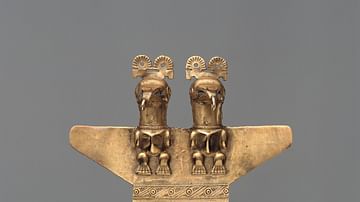
Muisca Double Eagle Pendant
A Muisca (Chibcha) double eagle gold pendant. Colombia, 10th-16th century CE. (Metropolitan Museum of Art, New York)
