
Search
Remove Ads
Advertisement
Search Results

Definition
Khmer Empire
The Khmer empire was a powerful state in South East Asia, formed by people of the same name, lasting from 802 CE to 1431 CE. At its peak, the empire covered much of what today is Cambodia, Thailand, Laos, and southern Vietnam. By the 7th...

Definition
Wolof Empire
The Wolof (aka Jolof or Djolof) Empire was a state on the coast of West Africa, located between the Senegal and Gambia rivers, which thrived from the mid-14th to mid-16th century CE. The empire prospered on trade thanks to the two rivers...

Definition
Oyo Empire
The Oyo Empire flourished from the 17th to 19th century CE in what is today southwest Nigeria. The Oyo forged an empire thanks to their formidable cavalry units and so came to dominate other Yoruba peoples of the region. The Oyo Empire, with...

Definition
Portuguese Empire
The Portuguese Empire was established from the 15th century and eventually stretched from the Americas to Japan. Very often a string of coastal trading centres with defensive fortifications, there were larger territorial colonies like Brazil...

Article
Pizarro & the Fall of the Inca Empire
In 1533 CE the Inca Empire was the largest in the world. It extended across western South America from Quito in the north to Santiago in the south. However, the lack of integration of conquered peoples into that empire, combined with a civil...

Article
The Alamo - The Mission, The Fortress, The Shrine
The poster for John Wayne's The Alamo (1960) celebrates its history with the line, "The Mission That Became a Fortress…The Fortress That Became A Shrine…," which is a concise and accurate summary of the story of the structure famously known...

Interview
Rubin Museum's Faith and Empire: Tibetan Buddhist Art
Faith and Empire: Art and Politics in Tibetan Buddhism, a new exhibition at the Rubin Museum of Art in New York, explores the dynamic historical intersection of politics, religion, and art as reflected through Tibetan Buddhism. The exhibition...

Video
Mexican Day of the Dead
In 2015 the British Museum celebrated the Days of the Dead in a four-day festival full of colour, music, storytelling and art. This beautiful documentary introduces the history and evolution of the Mexican Day of the Dead, from its pagan...
Article
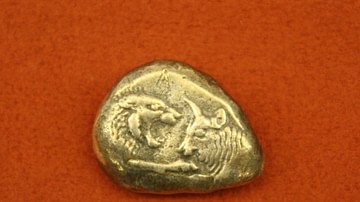
The Importance of the Lydian Stater as the World's First Coin
The Lydian Stater was the official coin of the Lydian Empire, introduced before the kingdom fell to the Persian Empire. The earliest staters are believed to date to around the second half of the 7th century BCE, during the reign of King Alyattes...

Definition
James 'Jim' Bowie - Accidental Hero of the Alamo
James 'Jim' Bowie (1796-1836) was a frontiersman, land speculator, slave trader, and militia officer who became a legendary figure following the Sandbar Fight in 1827, an event that also made the Bowie Knife famous, and an international hero...
