
Search
Remove Ads
Advertisement
Search Results

Definition
Shinto
Shinto means 'way of the gods' and it is the oldest religion in Japan. Shinto's key concepts include purity, harmony, family respect, and subordination of the individual before the group. The faith has no founder or prophets and there...
Definition
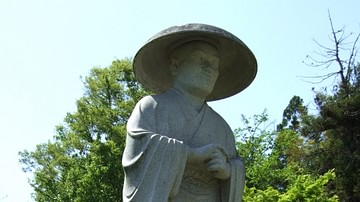
Ennin
Ennin (c. 793-864 CE, posthumous title: Jikaku Daishi) was a Japanese Buddhist monk of the Tendai sect who studied Buddhism at length in China and brought back knowledge of esoteric rituals, sutras, and relics. On his return, he published...

Definition
Heiankyo
Heiankyo (Kyoto), located in the centre of Honshu island, was the capital of Japan for over a thousand years and gave its name to one of the golden ages of Japanese history, the Heian Period (794-1185 CE). Built according to Chinese...

Image
Map of Japan in the 16th Century CE
A map of Japan during the Azuchi-Momoyama period (1568-1600 CE).

Image
Major Temples and Shrines of Japan circa 1200 CE, Kamakura Shogunate
This map depicts all major Buddhist temples and Shinto shrines of Japan around the year 1200 CE. Notice that many renowned temples (such as the famous Kinkaju-ji) have not yet been built...

Image
Sea Routes from Ancient Japan to China
A map illustrating possible sea routes used for political and cultural embassies from ancient Japan to Tang Dynasty China.

Image
Kinkakuji Temple in Kyoto, Japan
Kinkakuji Temple or the "Temple of the Golden Pavilion" was constructed in the 1390s CE as the retirement villa for Shogun Ashikaga Yoshimitsu (r. 1368–1394 CE). It is comprised of a three-story pavilion — covered...

Definition
Ninja
Ninja (aka Shinobi) were the specialised assassins, saboteurs, and secret agents of medieval Japanese warfare who were highly-trained proponents of the martial arts, especially what later became known as ninjutsu or 'the art of the ninja'...

Image
Japan's Kamikaze Warfare (1944–1945) - Japan's Organized Special Attack Campaign in WW II
Kamikaze or Tokkō (short for Tokubetsu Kōgekitai, "Special Attack Units") was Japan's organized campaign of deliberate suicide attacks during the final phase of the Second...

Image
The Seven Lucky Gods of Japan - Seven Deities, Countless Blessings
The Seven Lucky Gods of Japan (Shichifukujin) are a group of deities associated with prosperity, happiness, and longevity. Blending Shinto, Buddhist, Taoist, and even Hindu influences, they...
