
Search
Remove Ads
Advertisement
Search Results

Image
Helios Red-Figure Vase
A red-figure kalyx-krater depicting the sun god Helios. The stars are represented by young male children descending into the ocean. Attica, c. 430 BCE. (British Museum, London)
Image
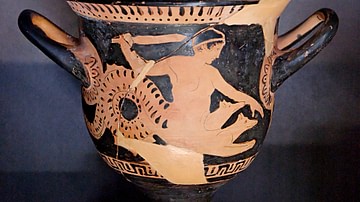
Scylla, Red-Figure Vase
A red-figure vase depicting Scylla, the monster who preyed on victims going through the Straits of Messina. Boeotian, 450-425 BCE.
Louvre Museum, Paris.

Image
Red Dots Cluster, Chauvet Cave (Replica)
Replica seen in The Cavern of the cluster of red dots seen in Chauvet Cave. The art in Chauvet Cave has been dated to between c. 33,000-c.30,000 years old.

Image
Man in a Red Turban by Jan van Eyck
The Man in a Red Turban painting by the Netherlandish Renaissance artist Jan van Eyck (c. 1390-1441 CE). Believed to be a self-portrait. 1433 CE. (National Gallery, London)

Image
British Red Coat, 1767
An 1894 illustration showing the uniform of a Grenadier, 40th Foot regiment, 1767. The soldier is wearing his famous "red coat" made with cochineal dye. From R. H. Raymond Smythies (1894). Historical Records of the 40th...
Image
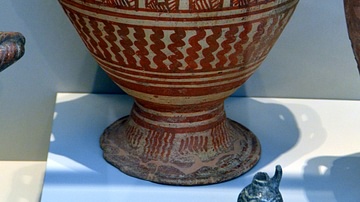
Etruscan Red on White Pottery Vessel
An Etruscan red on white slip pottery vessel from Vulci or Bisencio, c. 700 BCE. (Antikensammlung Berlin)

Image
Red-figure Hydria
A red-figure hydria by the Kleophon Painter, 440-430 BCE. The scene depicts women dressing. (National Archaeological Museum, Athens)
Image
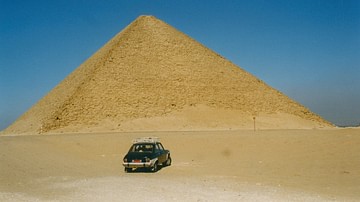
Red Pyramid
The Red Pyramid at Dahshur, by Sneferu (4th Dynasty), was constructed on a solid base for stability, rising at a 43-degree angle, using reddish limestone.
Image
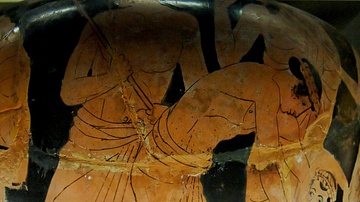
Red-figure Stamnos Depicting Philoctetes
Philoctetes, wounded, is abandoned by the Greek expedition en route to Troy, detail of an Attic red-figure stamnos, c. 460 BCE.
Louvre, Paris.
Image
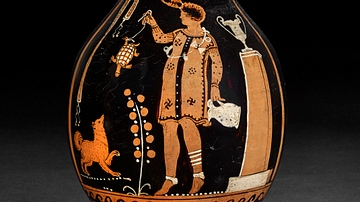
Red-figured Jug - Girl Playing with Tortoise
Red-figured chous (jug). Girl playing with tortoise: in her left hand she holds a white oinochoe; in the right she holds out a tortoise, by a string tied to its hind-leg, to a spaniel to right which looks...
