
Search
Remove Ads
Advertisement
Search Results

Definition
Etruscan Art
The art of the Etruscans, who flourished in central Italy between the 8th and 3rd century BCE, is renowned for its vitality and often vivid colouring. Wall paintings were especially vibrant and frequently capture scenes of Etruscans...

Definition
Samos
Samos is a Greek island in the east Aegean, just off the coast of modern-day Turkey. It particularly flourished in the 6th century BCE and was famous in antiquity for its navy, wine, and important sanctuary to Hera. Samos was an active...

Article
Sources of History
History (from the Greek ἱστορία, meaning 'a learning or knowing by inquiry') can be broadly taken to indicate the past in general but is usually defined as the study of the past from the point at which there were written sources...
Article
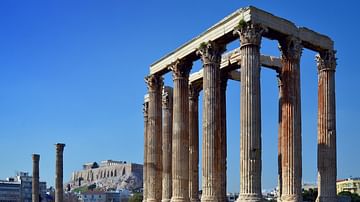
Temple of Olympian Zeus, Athens
The Temple of Olympian Zeus in Athens, also known as the Olympieion, was built over several centuries starting in 174 BCE and only finally completed by Roman emperor Hadrian in 131 CE. Its unusually tall columns and...

Article
Etruscan Tomb Paintings
The Etruscans flourished in central Italy from the 8th to 3rd century BCE, and one of their greatest legacies is the beautifully painted tombs found in many of their important towns. Tarquinia, Cerveteri, Chiusi, and Vulci...

Article
Visitor's Guide to Ancient Dion
Dion is located at the foot of Mount Olympus in the north of Greece, in what would have been ancient Macedon. It takes its name from the most important Macedonian sanctuary dedicated to Zeus ("Dios” meaning "of Zeus”...
Article
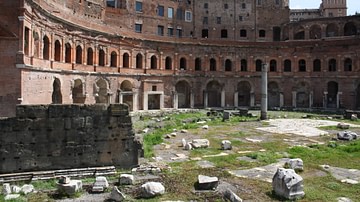
Trajan's Market
Trajan's Market is the name given in the early 20th century CE to a complex of buildings in the imperial fora of Rome constructed in 107-110 CE during the reign of Trajan. The complex included a covered market, small shop fronts...

Image
Renaissance Tomb in Petra
The so-called Renaissance Tomb, located in the Wadi Farasa in Petra (Jordan), has an elegant façade evoking elements of Italian Renaissance architecture, hence its name. The tomb façade consists of a triangular pediment...

Image
Roman Temple-tombs
Two monumental temple-tombs in the ancient city of Imbriogon in Cilicia (modern-day Turkey) dating to the second and third centuries CE. The overall design of the tombs with columns and a standard entablature produces the effect...
Image
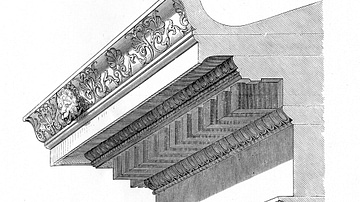
Cornice, Temple of Athena, Priene
The entablature of the Temple of Athena, Priene (Turkey), 340-156 BCE. The cornice decoration includes egg-and-tongue designs and also visible is a lion-head water spout.
