
Search
Remove Ads
Advertisement
Search Results

Article
Dogen's One Bright Pearl & the Neo-Confucian Pattern
The concept of Oneness is expressed repeatedly in philosophical works both in the east and west. Whether one is reading the Paradoxes of Zeno of Elea (l. c. 465 BCE) or the treatises of Wonyho (l. 617-686 CE) the concept of the One is impossible...
Image
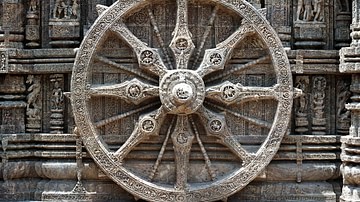
Dharma Wheel
The Dharmachakra (Skt: wheel of the law with eight spokes) represents the Eightfold Path (Right View, Right Resolve, Right Speech, Right Actions, Right Occupation, Right Effort, Right Mindfulness, and Right Concentration). Konark Sun temple...

Definition
Roman Government
Western Civilization is forever indebted to the people of ancient Greece and Rome. Among the numerous contributions these societies made are in the fields of art, literature and philosophy; however, perhaps their greatest gift to future generations...

Definition
Battle of Thermopylae
Thermopylae is a mountain pass near the sea in northern Greece which was the site of several battles in antiquity, the most famous being that between Persians and Greeks in August 480 BCE. Despite being greatly inferior in numbers, the Greeks...

Definition
Ashoka the Great
Ashoka the Great (r. 268-232 BCE) was the third king of the Mauryan Empire (322-185 BCE) best known for his renunciation of war, development of the concept of dhamma (pious social conduct), and promotion of Buddhism as well as his effective...

Definition
Hinduism
Hinduism is the oldest religion in the world, originating in Central Asia and the Indus Valley, still practiced in the present day. The term Hinduism is what is known as an exonym (a name given by others to a people, place, or concept) and...
Definition
Heian Period
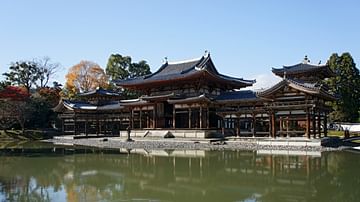
The Heian Period of Japanese history covers 794 to 1185 CE and saw a great flourishing in Japanese culture from literature to paintings. Government and its administration came to be dominated by the Fujiwara clan who eventually were challenged...

Definition
Thutmose III
Thutmose III (also known as Tuthmosis III, r. 1458-1425 BCE) was the 6th king of Egypt's 18th Dynasty, one of the greatest military leaders in antiquity, and among the most effective and impressive monarchs in Egypt's history. His throne...

Definition
Vespasian - The Commoner Who Became Roman Emperor
Vespasian (9-79 CE) was Roman emperor from 69 to 79 CE. Despite his low birth, he worked hard to rise through the ranks of Roman politics and eventually achieved prominence as a military commander. He came to power at the end of the brief...

Definition
Ancient Persian Religion
Ancient Persian religion was a polytheistic faith which corresponds roughly to what is known today as ancient Persian mythology. It first developed in the region known as Greater Iran (the Caucasus, Central Asia, South Asia, and West Asia...
