
Search
Did you mean: Hesiod?
Remove Ads
Advertisement
Search Results

Definition
Ancient Persian Art and Architecture
Persian art and architecture in the present day is associated with the nation of Iran and usually designated as beginning with the Achaemenid Empire (c. 550-330 BCE) but has an even longer history with its origins dating back to before the...

Definition
Prince Henry the Navigator
Prince Henry the Navigator (aka Infante Dom Henrique, 1394-1460) was a Portuguese prince who famously helped capture the North African city of Ceuta, sponsored voyages of exploration with the aim of building colonies in the North Atlantic...

Definition
Ancient Korean Architecture
The architecture of ancient Korea is epitomised by the artful combination of wood and stone to create elegant and spacious multi-roomed structures characterised by clay tile roofing, enclosures within protective walls, interior courtyards...

Definition
Steam Hammer
The steam hammer was developed in 1839 by the Scotsman James Nasmyth (also spelt Naysmyth, 1808-1890). Coming in a wide range of dimensions, the steam-powered machine was used to forge and shape very large pieces of metal for industrial use...

Definition
Penny Black - The World's First Postage Stamp
People have been sending letters to each other ever since paper and pen were invented, but it was not until 1840 that a new idea was introduced where people could prepay the cost of delivering their letter to their chosen destination using...

Definition
Parthian Art
Parthian art flourished within the Eurasian cultural corridor from the late hundreds BCE to the early 1st and 2nd centuries CE. With the Parthian Empire (247 BCE - 224 CE) stretching from India and China in the east to the Mediterranean shores...
Definition
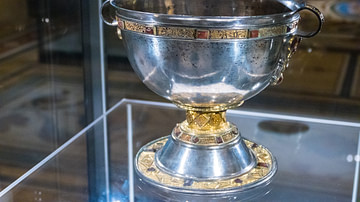
Derrynaflan Hoard
The Derrynaflan Hoard is a collection of Irish altar vessels dating between the 8th and 9th centuries CE. Discovered on the island of Derrynaflan, in the townland of Lurgoe, Co. Tipperary in 1980 CE, the pieces are now on display at the National...

Article
Patrons & Artists in Renaissance Italy
During the Renaissance, most works of fine art were commissioned and paid for by rulers, religious and civic institutions, and the wealthy. Producing statues, frescoes, altarpieces, and portraits were just some of the ways artists made a...

Article
Traditional Maori Tattoo of New Zealand
Te Papa Tongawera (or simply Te Papa) is New Zealand's innovative national museum situated near the foreshore of beautiful Wellington harbour. Te Papa Tongawera means “container of treasures” in Te Reo Maori, which is the indigenous language...

Article
Celtic Bronze Shields
The ancient Celts produced magnificent bronze shields in Iron Age Britain which were most likely for ceremonial purposes and display. Several fine examples have miraculously survived as evidence of the imagination, skill, and artistry of...
