
Search
Did you mean: Dacia?
Remove Ads
Advertisement
Search Results

Definition
Legio XXI Rapax
Legio XXI Rapax was a legion of the Roman army whose name name "Rapax" means "rapacious" or "greedy". It is not clear when the legion assumed this name; it may or may not be the same 21st legion Julius Caesar (100-44 BCE) formed before his...

Image
Map of the Roman Empire under the Flavians (69–96 CE) - Stability after Civil War
The territorial organization of the Roman Empire at the close of the Flavian dynasty (69–96 CE) reflects a period of consolidation following the political crisis that ended the Julio-Claudian line. After the turmoil of the Year of the Four...
Image
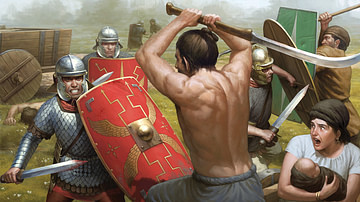
Romans Fighting Dacian & Germanic Warrriors
A depiction of Roman soldiers battling Dacian and Germanic warriors during the conquest of Dacia by the Roman emperor Trajan (r. 98-117 CE). By Darren Tan.
Courtesy of Ancient Warfare Magazine / Karwansaray Publishers.

Article
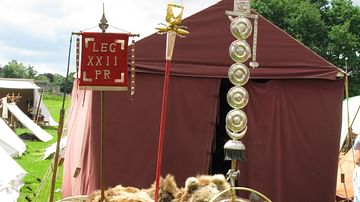
Legions of the Parthian Wars
Parthia had always been a thorn in the side of the Roman Empire. The initial campaigns by Crassus and Mark Antony were total failures, and although Trajan and Syrian governor Cassius made some progress in the 2nd century CE, both failed to...
Article
Legions of the Rhine Frontier
After Julius Caesar’s (100-44 BCE) conquest of Gaul, Roman legions pushed the borders of the Roman Empire’s frontier to the banks of the Rhine River. Augustus (r. 27 BCE - 14 CE) divided the newly acquired region into three provinces: Gallia...

Article
Legions of Pannonia
Located west of the Danube, Pannonia was essential for the protection of the Roman Empire's eastern frontier. It had been occupied since 9 BCE but did not willingly accept Roman authority. Pannonia and Dalmatia revolted in 6 CE, and it would...
Image
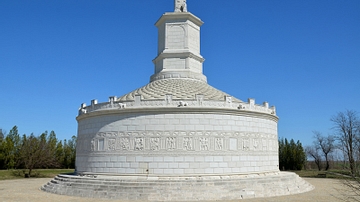
Tropaeum Traiani (Trajan’s Trophy)
The Tropaeum Traiani is a triumphal monument built in 109 CE in then Moesia Inferior (present-day Romania) to commemorate Trajan’s victory over the Dacians in 102 CE, in the Battle of Tapae. By the 20th century CE, the monument was reduced...
Image
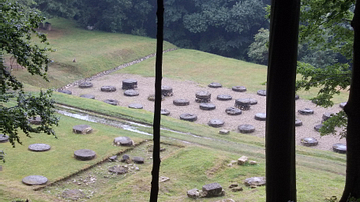
Limestone Sanctuary, Sarmizegetusa Regia
The large limestone sanctuary at Sarmizegetusa Regia was a religious building within the sacred area of the Dacian capital. It was build when Dacian king Burebista (82/61 – 44 BCE) moved his capital to Sarmizegetusa in 1st century BCE. The...

Video
The Parthian - Ancient Rome Live
The Parthian (from Parthia, whose empire essentially substituted the earlier Persian Empire from 247 BCE- 224 CE), in Roman art is depicted to show the Roman foe from Parthia in a submissive light, kneeling or with hands held together...
