
Search
Remove Ads
Advertisement
Search Results

Definition
Roger Mortimer - The Most Traitorous Earl of Edward II's Court
Roger Mortimer, 1st Earl of March (1287-1330) was an English nobleman who deposed King Edward II of England (reign 1307-1327) and then established himself as the kingdom's de facto ruler. Though...

Definition
Darius I
Darius I (l. c. 550-486 BCE, r. 522-486 BCE), also known as Darius the Great, was the third Persian King of the Achaemenid Empire. His reign lasted 36 years, from 522 to 486 BCE; during this time the Persian Empire reached its peak...

Definition
Ancient Persian Religion
Ancient Persian religion was a polytheistic faith which corresponds roughly to what is known today as ancient Persian mythology. It first developed in the region known as Greater Iran (the Caucasus, Central Asia, South...

Definition
Pergamon
Pergamon (also Pergamum) was a major intellectual and cultural center in Mysia (northwest Asia Minor, modern-day Turkey) which flourished under the Attalid Dynasty (281-133 BCE) during the Hellenistic Period. It was the capital of the...

Definition
Faravahar
The faravahar is the best-known symbol from ancient Persia of the winged sun disk with a seated male figure in the center. It is thought to represent Ahura Mazda, the god of Zoroastrianism, but has also been interpreted to signify...

Definition
Mithra
Mithra is the Persian god of the rising sun, contracts, covenants, and friendship. He also oversaw the orderly change of the seasons, maintained cosmic order, and was responsible for bestowing divine grace on kings, legitimizing their...

Video
2600 years of history in one object (Neil MacGregor)
http://www.ted.com A clay cylinder covered in Akkadian cuneiform script, damaged and broken, the Cyrus Cylinder is a powerful symbol of religious tolerance and multi-culturalism. In this enthralling...
Image
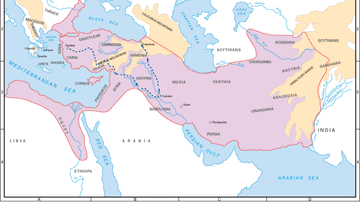
Map of Persia and the March of the Ten Thousand
A map of Persia, indicating major settlements, regions, and mountain ranges, as well as the march of the Ten Thousand (dotted line). The Ten Thousand were a group of mercenary units, mainly Greek, drawn...

Definition
Claudius - The Unlikely Roman Emperor
Claudius (10 BCE to 54 CE) was the fourth Roman emperor, who reigned from 41 to 54 CE. Though a member of the imperial Julio-Claudian Dynasty, his rise to power had always seemed unlikely. Indeed, for much of his...

Definition
Poppaea Sabina
Poppaea Sabina (30-65 CE) was the wife of Praetorian prefect Rufrius Crispinius and then Marcus Salvius Otho (r. 69 CE) before she became the second wife of Roman emperor Nero (r. 54-68 CE). Considered by ancient sources both attractive...
