
Search
Did you mean: Euclid?
Remove Ads
Advertisement
Search Results

Image
Eros Stringing His Bow
Marble statue of Eros stringing his bow. This statue is a 2nd-century CE Roman copy after a 4th-century BCE Greek original by Lysippos (Capitoline Museums, Rome).
Image
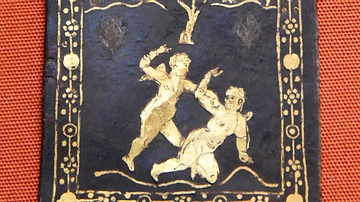
Bronze Plaque Showing Cupids Wrestling & Boxing
The background metal is bronze containing traces of a gold and silver, and its surface has been deliberately darkened, perhaps by organic acids. It may be an example of what Pliny calls "Corinthian bronze"...
Image
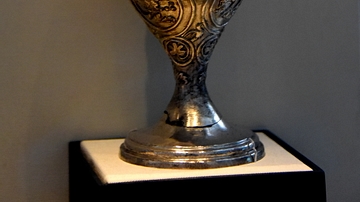
Flask from the Esquiline Treasure
This vessel was used for serving drinks at high status dinners. Typically, item like this was inscribed with good wishes for their users. The flask is decorated with cupids, animals, and fruit. Part of the Esquiline...

Article
A Brief History of the Rose
The rose that grows in many different forms in gardens all over the world today is an evolution of rose-like plants that lived in the northern hemisphere between 33 million and 23 million years ago. Traces of them have...

Article
Pompeii: Graffiti, Signs & Electoral Notices
The Roman town of Pompeii was preserved in metres of volcanic material following the cataclysmic eruption of Mt. Vesuvius in 79 CE. Often, we may experience the ancient past only through the second-hand...

Article
How Christmas Was Shaped by 19th-Century Literature
How we celebrate Christmas today is largely shaped by a small group of authors who recorded festive traditions in the 19th century. These authors include Washington Irving (1783-1859), Clement Clarke...

Article
8 Sonnets and Songs by William Shakespeare
The literary works of William Shakespeare (l. c. 1564-1616) are often regarded as some of the most important in the English language. Alongside his famous plays, he also wrote poems, including 154 sonnets...
Image
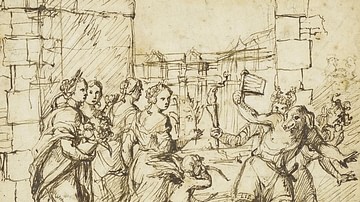
Lupercalia in Ancient Rome
The Lupercalian festival in Rome: Cupid and Personifications of Fertility encounter the Luperci dressed as dogs and goats, a pen and ink drawing by the Circle of Adam Elsheimer (1578-1610).
Image
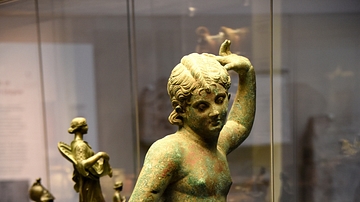
Statuette of a Boy
This bronze statuette probably represents cupid (god of love, attraction, and affection). Said to be from Foggia, in modern-day Italy. Roman period, 10-100 BCE. (The British Museum, London).

Video
Courtly Love in the High Middle Ages
Courtly Love is a literary genre of poetry that began in the south of France in the 12th century during the period known as the High Middle Ages. In this new genre of poetry, motifs were established that are still...
