
Search
Did you mean: Krak Des Chevaliers?

 This answer was generated by
 Search Results

Definition
Krak Des Chevaliers
Krak des Chevaliers (also spelt Cracs des Chevaliers, and known in Arabic as Hisn al-Akrad) is a castle in Syria originally built for the Emir of Aleppo in 1031 CE but acquired and extensively rebuilt by the Knights Hospitaller in 1144 CE...

Video
Crac des Chevaliers and Qal'at Salah El-Din (UNESCO/NHK)
These two castles represent the most significant examples illustrating the exchange of influences and documenting the evolution of fortified architecture in the Near East during the time of the Crusades (11th - 13th centuries A.D.). They're...
Image
Krak des Chevaliers
The castle of Krak des Chevaliers, Syria. Originally built for the Emir of Aleppo in 1031 CE, the castle was given to the Knights Hospitaller in 1144 CE, who extensively rebuilt it.
Image
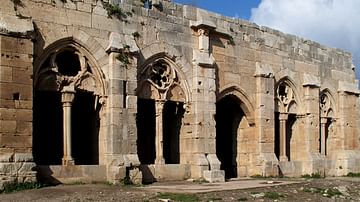
Hall of the Knights, Krak des Chevaliers
The Hall of the Knights at the castle of Krak des Chevaliers, Syria. Originally built for the Emir of Aleppo in 1031 CE, the castle was given to the Knights Hospitaller in 1144 CE, who extensively rebuilt it.

Image
Barrel-vaulted Chapel, Krak des Chevaliers
The barrel-vaulted chapel of the castle of Krak des Chevaliers, Syria. Originally built for the Emir of Aleppo in 1031 CE, the castle was given to the Knights Hospitaller in 1144 CE, who extensively rebuilt it.
Image
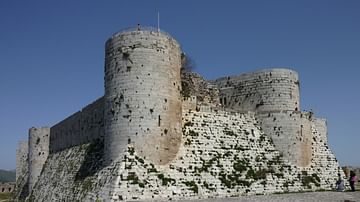
Mural Towers, Krak des Chevaliers
Mural towers of the castle of Krak des Chevaliers, Syria. Originally built for the Emir of Aleppo in 1031 CE, the castle was given to the Knights Hospitaller in 1144 CE, who extensively rebuilt it.
Image
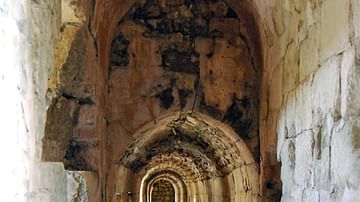
Mural Passage, Krak des Chevaliers
A mural passage (corridor built within a wall) at the castle of Krak des Chevaliers, Syria. Originally built for the Emir of Aleppo in 1031 CE, the castle was given to the Knights Hospitaller in 1144 CE, who extensively rebuilt it.
Image
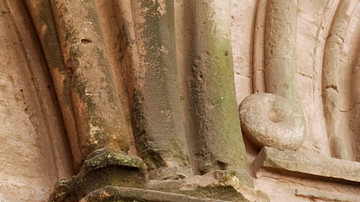
Decorative Corbel, Krak des Chevaliers
A decorative corbel at the castle of Krak des Chevaliers, Syria. Originally built for the Emir of Aleppo in 1031 CE, the castle was given to the Knights Hospitaller in 1144 CE, who extensively rebuilt it.

Image
Bal des Ardents
Bal des Ardents or the Ball of the Burning Men (28 January 1393), illustration in the Chronicles of Jean Froissart, FR 2646, folio 176 recto, 15th century.
Bibliothèque nationale de France, Paris.
Image
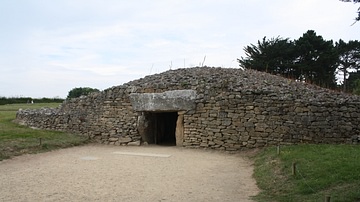
Table-des-Marchands Tumulus, Locmariaquer
The stone burial mound known as the Table-des-Marchands (Table of Merchants) at the Neolithic site of Locmariaquer in north-west France. The tomb was constructed in the 5th millennium BCE and is so called because of the large flat stone which...
