
Search
Remove Ads
Advertisement
Search Results

Image
Abbey of Saint John at Müstair, Switzerland
The Abbey of Saint John at Müstair, located in the village of Müstair in Canton Graubünden, Switzerland, is an early medieval Benedictine monastery dating to the late 8th century CE. It became an abbey in 1163 CE and still functions as a...
Image
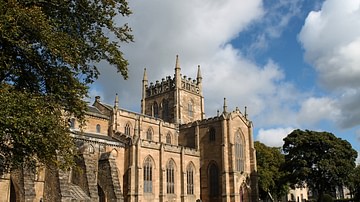
Dunfermline Abbey
Dunfermline Abbey, Fife, Scotland. The abbey was refounded around 1150 during the reign of David I of Scotland (r. 1124-1153). It contains the remains of Saint Margaret of Scotland and Robert the Bruce, amongst others.
Image
Fountains Abbey
The ruins of Fountains Abbey, North Yorkshire, England. Founded in 1132 CE, the Cistercian abbey was closed in 1539 CE as part of the Dissolution of the Monasteries during the reign of Henry VIII of England (r. 1509-1547 CE).
Image
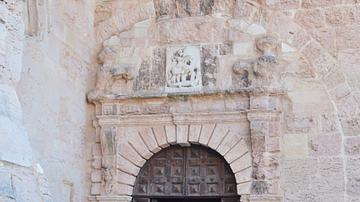
Door of the Abbey of St. Victor, Marseille
Door to the Abbey of Saint Victor in Marseille. Above the door is medieval rock carving possibly executed during the rebuilding of the abbey in the 11th and 12th centuries CE.

Definition
Medieval Monastery
A medieval monastery was an enclosed and sometimes remote community of monks led by an abbot who shunned worldly goods to live a simple life of prayer and devotion. Christian monasteries first developed in the 4th century in Egypt and Syria...

Image
Tomb of Richard I of England, Fontevraud Abbey
An effigy of Richard I of England (r. 1189 - 1199 CE), popularly known as Richard the Lionheart, from his tomb in Fontevraud Abbey in France.
Image
Whitby Abbey
Whitby Abbey, North Yorkshire, England. Founded in the 7th century CE.
Image
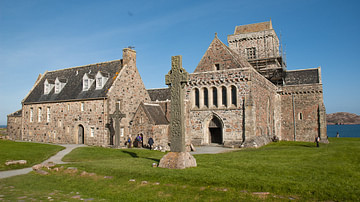
Iona Abbey
Iona Abbey, Scotland.
Image
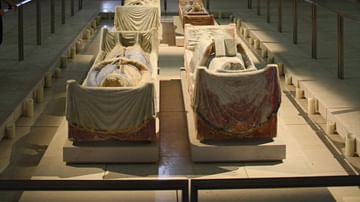
Fontevraud Abbey Church Interior
The interior of the church at Fontevraud Abbey, France. The four tombs belong to Henry II of England (r. 1154-1189) and his wife Eleanor of Aquitaine (l. c. 1122-1204), Richard I of England (r. 1189-1199), and Isabella of Angoulême (c. 1186-1246...
Image
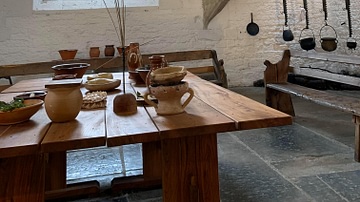
The Abbot's Kitchen Interior - Glastonbury Abbey
The Abbot's Kitchen at Glastonbury Abbey is known for its four large fireplaces. The building dates from the 14th century CE and is also known as "one of the best-preserved medieval kitchens in Europe".
