
Search
Did you mean: Venus?
Remove Ads
Advertisement
Search Results

Definition
Möngke Khan
Mongke Khan was ruler of the Mongol Empire (1206-1368 CE) from 1251 to 1259 CE. As the third Great Khan or 'universal ruler' of the Mongols, Mongke would oversee administrative reforms that continued to centralise government and ensure he...

Definition
Seshat
Seshat (also given as Sefkhet-Abwy and Seshet) is the Egyptian goddess of the written word. Her name literally means "female scribe" and she is regularly depicted as a woman wearing a leopard skin draped over her robe with a headdress of...
Definition
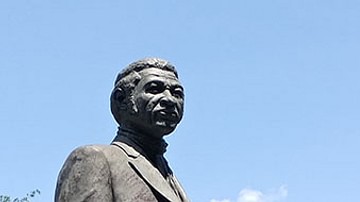
Denmark Vesey
Denmark Vesey (c. 1767-1822) was a free Black man living in Charleston, South Carolina, as a carpenter and community leader. A former slave himself, Vesey became involved in the antislavery movement and was accused of planning a large-scale...

Image
Roman Citizen Voting
A Roman coin depicting a citizen voting, silver denarius of L. Cassius Longinus, 63 BCE.
Archaeological Museum, Tarragona, Spain.

Article
Ancient Roman Society
Rome began as a small city on the banks of the Tiber River in Italy. The Latin tribes (also known as the Latini or Latians) inhabited the region c. 1000 BCE but the founding of the city is dated to 753 BCE. The family was the center and foundation...

Article
The Origin & History of the BCE/CE Dating System
The BCE/CE dating system was first used in the 17th century and has been used since in scholarly publications read by people of all faiths and cultures in an effort to be inclusive. This system is also more accurate in that it makes no claim...

Article
Reforms of Augustus
Emperor Augustus (27 BCE – 14 CE) accomplished much during his time on the Roman throne, far more than many of his successors. According to historian Mary Beard in her book SPQR, he transformed the structures of Roman Empire, including its...

Article
Agriculture in the British Industrial Revolution
Agriculture, like most other areas of working life, was greatly affected by the machines invented during the Industrial Revolution. Agriculture in Britain and elsewhere had made leaps forward in the 18th century, and its success released...

Article
Christiane Desroches Noblecourt - Strong as the Stones she was able to move
Her name echoes down the corridors, in classrooms and in books, Christiane Desroches Noblecourt was a great French Egyptologist and, in the opinion of the writer, a woman strong and determined enough to have been the first female to direct...

Definition
Mongol Empire
The Mongol Empire (1206-1368) was founded by Genghis Khan (r. 1206-1227), first Great Khan or 'universal ruler' of the Mongol peoples. Genghis forged the empire by uniting nomadic tribes of the Asian steppe and creating a devastatingly effective...
