
Search
Remove Ads
Advertisement
Search Results
Image
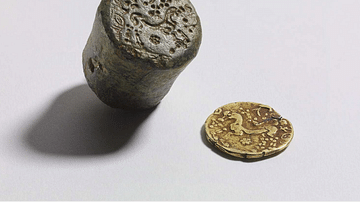
Celtic Coin Die & Gold Coin
A Celtic coin die and gold coin showing a horse design from Bredgar, Kent, England, 2nd century BCE.
The British Museum, London.

Image
Essendon Celtic Coin Hoard
A number of the gold coins found in the Celtic Essendon hoard from Hertfordshire, England. The hoard dates to the period c. 60 BCE to 40 CE. It is likely the coins were buried as a votive offering as the hoard was added...
Image
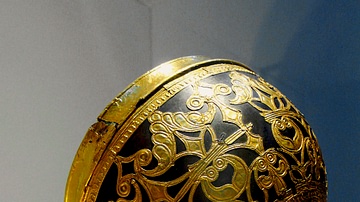
Celtic Bowl, Schwarzenbach Burial
A Celtic bowl with embossed gold leaf decoration from the princely burial at Schwarzenbach, Rhineland, Germany. 5th century BCE. (Staatliche Museen zu Berlin)

Image
Celtic Tripartite Vessel
A Celtic tripartite carinated pottery vessel. These vessels are made from three separate pieces, each with straight sides, which when assembled create an angular form. This example was found in a grave in the Marne region...
Image
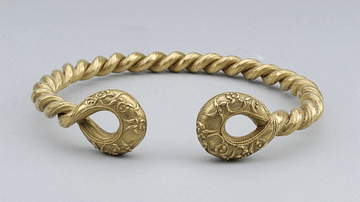
Celtic Torc, Belstead Brook
A gold alloy torc from the Belstead Brook hoard, Ipswich, England. Celtic, 150-50 BCE. Diameter 18.6 cm. (British Museum, London)
Image
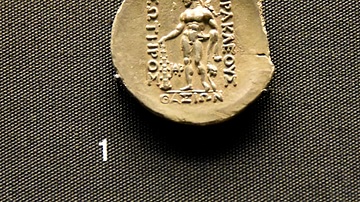
Celtic Coin Copying Greek Inscription
Early Iron Age Celtic people copied Greek coins, often faithfully reproducing their designs and inscriptions. This suggests that Thracian die-engravers were illiterate, as legible Greek letters were gradually...
Image
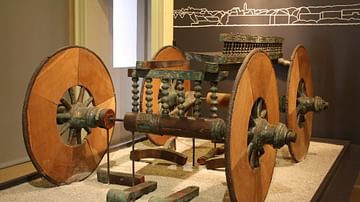
Celtic Wagon
The remains of a Celtic wagon in bronze with wood reconstruction. 5th century BCE. (Archaeological Museum of Como, Italy)

Image
Celtic Wine-Serving Vessels
Celtic vessels used for serving wine. Found in Waldalgesheim, western Germany. 330-320 BCE. (Rheinisches Landesmuseum, Bonn, Germany)
Image
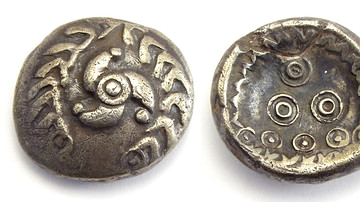
Celtic Regenbogenschüsselchen
An example of a Celtic coin known as a regenbogenschüsselchen of southern Germany and Bohemia. Electrum, 5th-1st century BCE.
Image
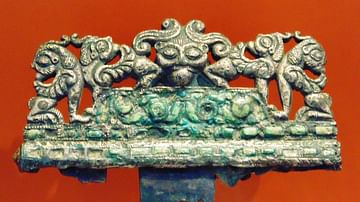
Celtic Belt Buckle
Celtic belt buckle, 5th century BCE.
Rheinisches Landesmuseum Trier, Germany.
