
Search
Remove Ads
Advertisement
Search Results

Definition
Renaissance Art
The art of the Renaissance period in Europe (1400-1600 CE) includes some of the most recognisable and best-loved paintings and sculptures in the world. Masters were often skilled in both painting and sculpture, and by studying...

Article
Buddhist Illuminated Scripts of Ancient Korea
The Goryeo (Koryo) kingdom ruled ancient Korea from 918 CE to 1392 CE, and it oversaw a flourishing of the arts, literature, and architecture. One of these developments was the production of finely crafted...

Definition
Ancient Persian Art and Architecture
Persian art and architecture in the present day is associated with the nation of Iran and usually designated as beginning with the Achaemenid Empire (c. 550-330 BCE) but has an even longer history with its origins...

Article
The Meaning of European Upper Paleolithic Rock Art
Rock art (also known as parietal art) is an umbrella term which refers to several types of creations including finger markings left on soft surfaces, bas-relief sculptures, engraved figures and symbols...

Definition
Ancient Israelite Art
Ancient Israelite art traditions are evident especially on stamps seals, ivories from Samaria, and carvings, each with motifs connecting it to more general artistic traditions throughout the Levant. Ancient Israel, and therefore...
Article
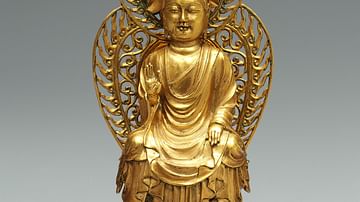
Buddhism in Ancient Korea
Buddhism, in Korean Bulgyo, was introduced by monks who visited and studied in China and then brought back various Buddhist sects during the Three Kingdoms period. It became the official state religion in all Three Kingdoms...

Article
A Brief History of Egyptian Art
Art is an essential aspect of any civilization. Once the basic human needs have been taken care of such as food, shelter, some form of community law, and a religious belief, cultures begin producing artwork, and often...

Definition
Viking Art
Art made by Scandinavians during the Viking Age (c. 790-1100 CE) mostly encompassed the decoration of functional objects made of wood, metal, stone, textile and other materials with relief carvings, engravings of animal shapes and...

Article
The Art of the Tang Dynasty
The art of the Tang Dynasty (618-907 CE) began to explore new possibilities in materials and styles with landscape painting and ceramics, in particular, coming to the fore. New techniques, a wider range of colours and...

Definition
Byzantine Art
Byzantine art (4th - 15th century CE) is generally characterised by a move away from the naturalism of the Classical tradition towards the more abstract and universal, there is a definite preference for two-dimensional representations...
