
Search
Did you mean: Boreas?

 This answer was generated by
 Search Results
Image
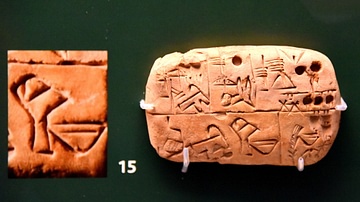
Bread Rations from Mesopotamia
In this food issue list, "rations" is written by combining a human head a bowl (a triangular object in front of the head). This combination, in later Sumerian texts, means "to eat". The triangular object was the regular representation of...
Image
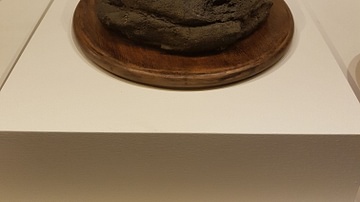
A Loaf of Bread from Herculaneum
A loaf of bread from Herculaneum. 79 CE. Museo Archeologico Nazionale di Napoli, (photo taken at the National Maritime Museum, Sydney Australia) Carbonised in the eruption of Mt. Vesuvius. Before the eruption, someone in Pompeii scratched...

Definition
Flour War
The Flour War refers to the series of approximately 300 riots that swept through France from April to May 1775, because of rising bread prices. The revolts only subsided after soldiers had been deployed, resulting in hundreds of arrests...
Image
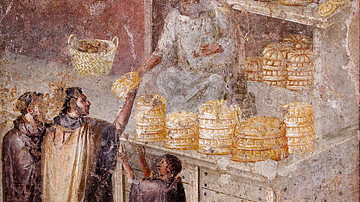
Sale of Bread Fresco, Pompeii
The so-called "Sale of Bread" fresco from the House of the Baker or Casa del Forno (c. 79 CE) in Pompeii, Italy. The fresco is misleadingly titled because it actually depicts the distribution of bread by a political candidate or politician...

Image
Jewish Bread-Stamp from Sardis
In the Late Roman Period, the Jewish faith was expressed through symbols of personal items in much the same way as for Christianity. The Jewish "Menorah" is depicted on this bread-stamp. The stamp bears the name of "Leontios", which perhaps...
Image
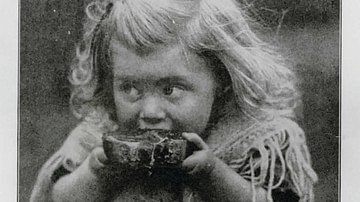
Young Girl Eating War Bread
A young girl eating war bread during the First World War (1914-1918).
Hoover Presidential Library, National Archives and Records Administration, Washington, D.C.
Video
Making 2,000-year-old bread
In AD 79, a baker put his loaf of bread into the oven. Nearly 2,000 years later it was found during excavations in Herculaneum. The British Museum asked Giorgio Locatelli to recreate the recipe as part of his culinary investigations for 'Pompeii...
Definition
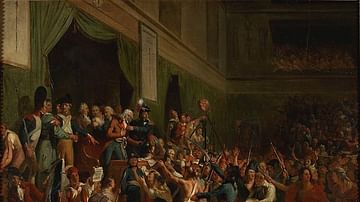
Prairial Uprising
The Uprising of 1 Prairial Year III (20 May 1795) was the last major popular insurrection during the French Revolution (1789-1799). It was the final time that the sans-culottes played an important role in French politics until the revolutions...

Article
Food & Drink in the Elizabethan Era
Food and drink in the Elizabethan era was remarkably diverse with much more meat and many more varieties of it being eaten by those who could afford it than is the case today. Storage of food was still a problem and so fresh produce was grown...

Article
Food & Drink in Ancient Egypt
Food and drink in ancient Egypt relied on barley and wheat, the primary crops cultivated along the Nile. The Egyptian diet was based on bread, beer, and vegetables. Meat was expensive and only rarely eaten. The majority of people ate fairly...
