
Search
Did you mean: Brahma?
Remove Ads
Advertisement

 This answer was generated by
 Search Results

Article
Caste System in Ancient India - Varna Ideals in Vedic Times
Ancient India in the Vedic Period (c. 1500-1000 BCE) did not have social stratification based on socio-economic indicators; rather, citizens were classified according to their Varna or castes. 'Varna' can literally mean 'colour' but in ancient...

Definition
Arjuna
Arjuna (also given as Arjun) is the great hero of the Indian epic Mahabharata and the philosophical-religious dialogue Bhagavad Gita. His name means “shining”, “silver” and similar terms relating to brightness. He is the most popular champion...

Definition
Kali
Kali is the Hindu goddess of death, time, and doomsday. She is often associated with sexuality and violence but is also considered a strong mother figure and symbol of motherly love. Kali embodies shakti – feminine energy, creativity and...

Definition
Chanakya
Chanakya (l. c. 350-275 BCE, also known as Kautilya and Vishnugupta) was prime minister under the reign of Chandragupta Maurya (r. c. 321-c.297 BCE), founder of the Mauryan Empire (322-185 BCE). He is best known as the author of the political...

Definition
Pandavas
Pandavas were the five powerful and skilled sons of Pandu, the King of Hastinapur and his two wives Kunti and Madri. Hastinapur is equated with the current modern Indian state of Haryana, south of New Delhi. The Pandavas – Yudhistira, Bhima...

Image
The Four Castes of Ancient India - The Varna System
This infographic illustrates the Varna caste system in ancient India. First mentioned in the Rig Veda's Purusha Sukta c. 1200–1000 BCE, it shows society divided into four groups that emerged from the sacrifice of Purusha, a transcendent and...
Definition
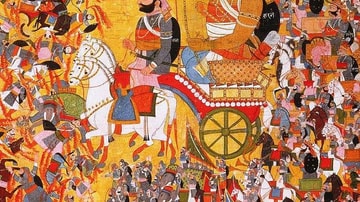
Mahabharata
The Mahabharata is an ancient Indian epic where the main story revolves around two branches of a family - the Pandavas and Kauravas - who, in the Kurukshetra War, battle for the throne of Hastinapura. Interwoven into this narrative are several...

Definition
Ashoka the Great
Ashoka the Great (r. 268-232 BCE) was the third king of the Mauryan Empire (322-185 BCE) best known for his renunciation of war, development of the concept of dhamma (pious social conduct), and promotion of Buddhism as well as his effective...

Definition
Hinduism
Hinduism is the oldest religion in the world, originating in Central Asia and the Indus Valley, still practiced in the present day. The term Hinduism is what is known as an exonym (a name given by others to a people, place, or concept) and...
Definition
Arthashastra
The Arthashastra is an Indian treatise on politics, economics, military strategy, the function of the state, and social organization attributed to the philosopher and Prime Minister Kautilya (also known as Chanakya, Vishnugupta, l. c. 350-275...
