
Search
Did you mean: Hestia?
Remove Ads
Advertisement
Search Results

Definition
Agesilaus II
Agesilaus II (c. 445 – 359 BCE) was a Spartan king who won victories in Anatolia and the Corinthian Wars but who would ultimately bring total defeat to his city through his policies against Thebes. When Sparta lost the crucial battle...

Image Gallery
A Panorama of Central Greece
The uniqueness of modern central Greece's landscape derives from the atmospheric blend of ancient archaeological sites and the Mediterranean flora. The forests are mostly composed of fir trees, pine trees, and bushes...

Article
The Plays of Cratinus
Cratinus was a highly successful writer of Attic Old Comedy, but the very fragmentary nature of his surviving plays means that he is not as well remembered as Aristophanes (eleven of whose plays come down to us intact). Despite...
Image
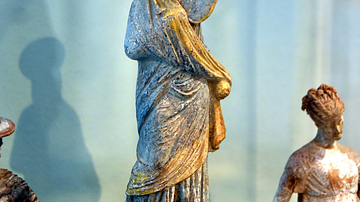
Tanagra Figurine
This small terracotta figurine is part of the so-called "Tanagra Figurines", which represent wealthy middle-class women. These statuettes served as votive and funerary objects, carrying a symbolic meaning connected with the status...
Image
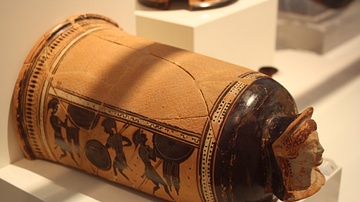
Epinetron
Epinetron (pl. epinetra) - a half-cyclinder worn over the thigh with the closed end over the knee, used for preparing wool for weaving. The upper surface was often incised to make a rough surface against which the wool fibres could...
Image
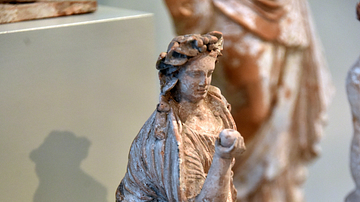
Tanagra Figurine of a Female
This small terracotta figurine is part of the so-called "Tanagra Figurines", which represent wealthy middle-class women. These statuettes served as votive and funerary objects, carrying a symbolic meaning connected with...
Image
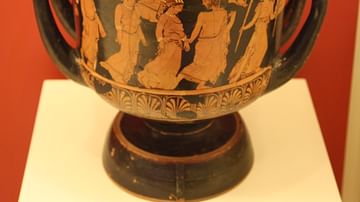
Calyx Krater
A red-figure calyx krater from Boeotia, c. 410 BCE. The scene depicts a wedding procession. (National Archaeological Museum, Athens)
Image
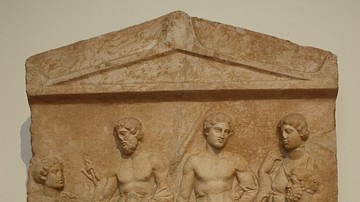
Boeotian Grave Stele
A Boeotian grave stele. 5th century BCE, Thespian marble. (National Archaeological Museum, Athens)
Image
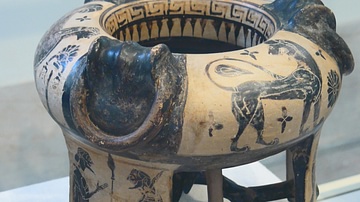
Boeotian Exaleiptron
A Boeotian tripod exaleiptron (also known as a kothon), mid-6th century BCE. These vessels were used for keeping fine oils and perfumes and had an inverted lip to reduce spillage.
Image
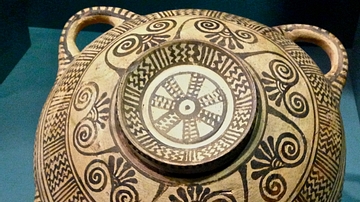
Boeotian Four-handled Bowl
While this class of bowl typically bears bird motifs on the outside, this example, dating to the mid-sixth century BCE, features the stylistic representation of plants and geometric motifs instead. The inside simply features...
