
Search
Remove Ads
Advertisement
Search Results
Image
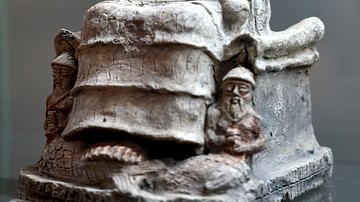
Babylonian Statue of Enki
A statue of Ea, the Akkadian god of water (related to the Sumerian god Enki). Ea is enthroned and holds a cup in his left hand, the right hand has been lost to time. He is accompanied by two creatures (half human and half fish) reclining...

Video
A Day in the Life of an Ancient Babylonian Business Mogul
Follow Beltani, a Babylonian priestess and businesswoman, as she investigates who is undermining her barley fields and tavern. — It's 1762 BCE. As dawn breaks in the Babylonian city of Sippar, Beltani— a priestess and businesswoman—...

Image
Stela from Babylonian Marduk Temple
This stela came from the Temple of Marduk in Babylon. It is a commemorative monument set up in honour of a private individual called Adad-Etir. He was an official in the temple, known as 'the dagger bearer', and this stela was erected by...

Image
Babylonian Cuneiform Lexical List
Late Babylonian lexical list of personal names on a clay tablet.
Image
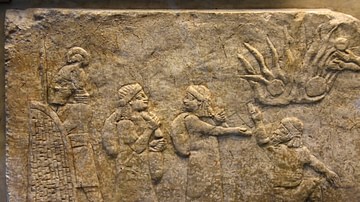
Assyrian Relief Showing Babylonian Prisoners
Assyrian alabaster panel showing Babylonian prisoners in a camp, from the North Palace at Nineveh, Northern Mesopotamia, modern-day Iraq, Neo-Assyrian Empire, reign of Ashurbanipal II, 668-630 BCE. To the left, an Assyrian soldier stands...

Definition
Tukulti-Ninurta I
Tukulti-Ninurta I (reigned 1244-1208 BCE) was a king of the Assyrian Empire during the period known as the Middle Empire. He was the son of Shalmaneser I (reigned 1274-1245 BCE) who had completed the work of his father, Adad Nirari I, in...
Image
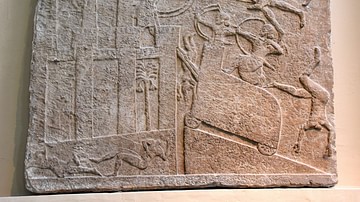
Babylonian City under Assyrian Siege
Assyrian relief showing a siege, from the Central Palace at Nimrud (ancient Kalhu), Mesopotamia, Iraq. Date palms indicate that the city, most of which was on an adjacent slab, was probably Babylonia. The Assyrians have built a siege ramp...
Image
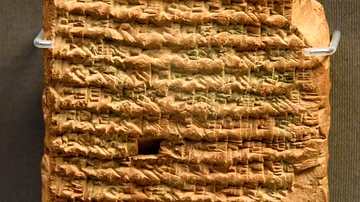
Babylonian Tablet Mentioning Coin Payments
This tablet records the exact coins required for transaction in Babylon. Because coins could circulate for many years, freshly minted coins were less worn and had a better silver weight. The tablet specifies the "staters of Seleucus with...
Image
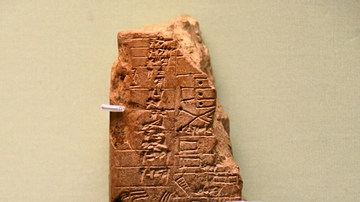
Secret Babylonian Numbers
A compendium of ancient signs united the knowledge of generations of scholars. It includes pictographic symbols from around 3000 BCE and a secret number for each sign, for encoding texts. Circa 450 BCE. Clay tablet. From Babylon, Mesopotamia...
Image
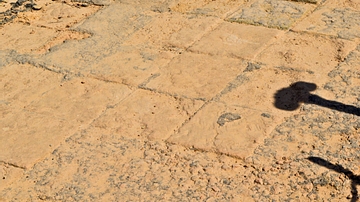
Babylonian Cobblestones
A close-up view of the original cobblestones of the Processional Street at Babylon. Note the black bitumen!
