
Search
Remove Ads
Advertisement
Search Results
Image
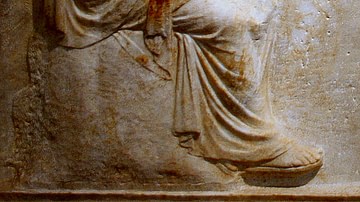
Apollo, detail from NAM, Athens, 215.
Detail of Apollo from NAM, Athens, 215. He is seated on a tree stump, wearing chlamys and chiton, and sandals. In his left hand he rests his seven string lyre (the stings would have been painted; the number of...
Image
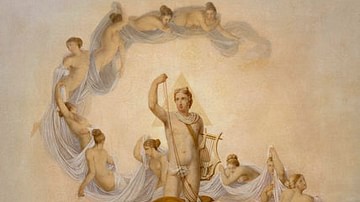
Apollo with the Hours
Apollo with the Hours, oil on canvas by Georg Friedrich Kersting (1785–1847), c. 1822.
Güstrow City Museum.
Image
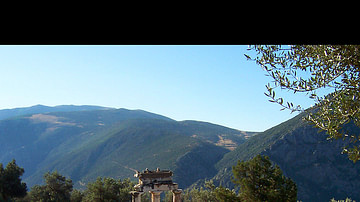
Sanctuary of Apollo in Delphi
Delphi was the site of the Delphic oracle, the most important oracle in the classical Greek world, when it was a major site for the worship of the god Apollo after he slew the Python, a deity who lived there and protected...
Image
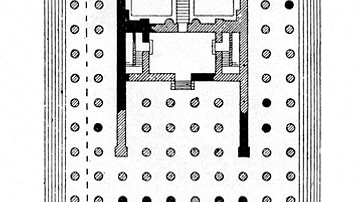
Aerial View of the Temple of Apollo, Miletus
An aerial view (2011 CE) of the temple of Apollo Didymaeus at Miletus (late 4th century BCE).
Image
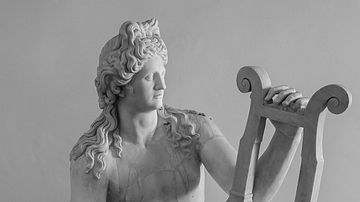
Apollo Citharoedus
Apollo Citharoedus; 1st century CE; Head, hands, left leg and the instrument were restored in 17th century CE; Palazzo Altemps in Rome, Italy.
Image
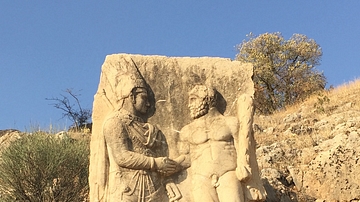
Apollo-Mithras Meets Antiochus I
Found in the ancient ruins of Arsameia, outside Kahta, Turkey, 15 km from the world heritage site of Nemrut Dagi, this stele portrays the meeting of Antiochus I (r. 70 BCE - c. 38 BCE) and Apollo. Antiochus - the...
Image
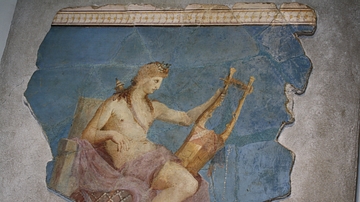
Apollo Playing the Kithara
A fresco of Apollo playing the kithara, from a building in the Forum of Rome. Augustan period. (Museum of the Forum Romanum, Rome)

Image
Belvedere Apollo
The Belvedere Apollo statue considered to be a 2nd century CE copy of a bronze statue of the 4th century BCE by Leochares. The god would have once held a bow in his left hand. (The Vatican Museums, Rome).

Image
Apollo and Diana Attacking the Children of Niobe
Apollo and Diana attacking the Children of Niobe, oil on canvas by Jacques-Louis David, 1772.
Dallas Museum of Art.

Image
Temple of Apollo, Delphi
The remains of the temple of Apollo, Delphi (4th century BCE). Site of the oracle and for the greeks the centre of the ancient world.
