
Search
Remove Ads
Advertisement

 This answer was generated by
 Search Results
Image
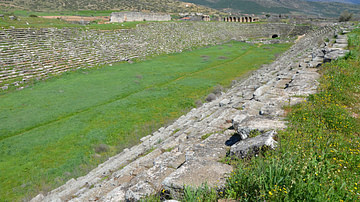
Aphrodisias Stadium
The Aphrodisias stadium, dated to the 1st century CE. It is the best-preserved stadium in Asia Minor. The stadium is 262 m in length and 52 m in width, with a seating capacity of 30,000 people.
Image
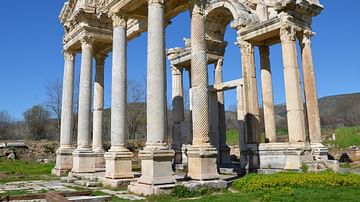
The Tetrapylon of Aphrodisias
The Tetrapylon of Aphrodisias in Caria (now Turkey) was a monumental gateway leading from the main north-south street of the town into a large forecourt in front of the Temple of Aphrodite. It was built c. 200 CE.
Image
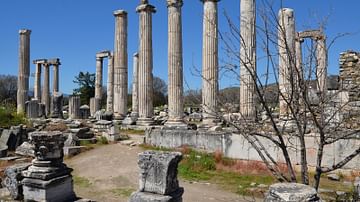
Temple of Aphrodite at Aphrodisias
The Ionic columns of the Temple of Aphrodite at Aphrodisias, later converted into a Christian basilica. First century BCE.
Image
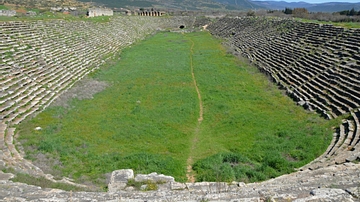
The Stadium of Aphrodisias
The Stadium is one of Aphrodisias' most remarkable surviving buildings. It was 270 m long and 59 m wide with 30 rows of seats. It had the capacity of 30,000 spectators. It is one of the best preserved ancient stadiums...
Image
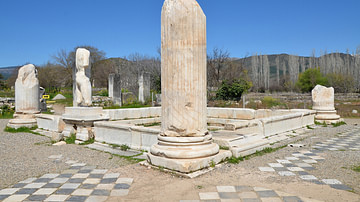
Baths of Hadrian at Aphrodisias
The pool of the tetrastyle court of the Baths of Hadrian richly decorated with columns, statues and marble ornamentation. It is the largest public bath building in Aphrodisias.
Image
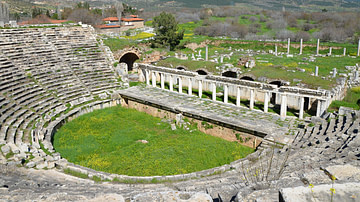
Roman Theatre at Aphrodisias, Caria
The Roman theatre of Aphrodisias in Caria (modern-day Turkey), built in the second half of the 1st century BCE on the eastern slope of the acropolis.
Image
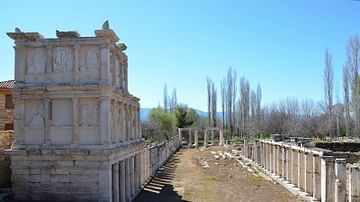
Sebasteion, Aphrodisias
General view of the Sebasteion with the restored portico with replicas of reliefs depicting various mythological subjects and members of the imperial family. Its construction began during the reign of Tiberius (14-37 AD...

Article
Top 10 Archaeological Sites in Caria, Turkey
Located at the crossroads of many ancient civilizations, Turkey is a haven for archaeology lovers. Over the centuries, a succession of empires and kingdoms – Hittite, Lydian, Persian, Greek, Roman, Byzantine...

Image
Relief with the Three Graces
Relief from the Sebasteion of Aphrodisias depicting the Three Graces in a typical Hellenistic style. The Sebasteion is a monumental complex dedicated to Aphrodite and the Julio-Claudian emperors in the 1st century CE...

Image
Nero and Agrippina
Relief from the Sebasteion depicting Nero and Agrippina on display in the Aphrodisias Museum. Agrippina crowns her young son Nero with a laurel wreath. The scene refers to Nero’s accession as emperor in 54 CE.
