
Search
Remove Ads
Advertisement
Search Results
Image
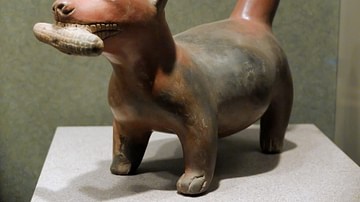
Colima Dog with Maize
Statue of a dog holding a cob of maize (corn) in its mouth, from Colima, Mexico, c. 100 BCE to 300 CE.
National Museum of Anthropology, Mexico City.

Image
Francisco Pizarro on Isla del Gallo
A 1902 painting by Juan Lepiani showing the conquistador Francisco Pizarro on Isla del Gallo on his second expedition to Peru in 1527. Recalled by the governor of Cuba, Pizarro ignored his orders and asked his men who would volunteer to proceed...
Image
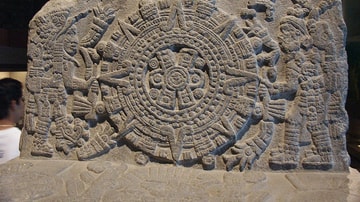
Throne of Motecuhzoma, Detail
A detail from the Throne of Motecuhzoma II otherwise known as the Monument of Sacred War. The sun disk in the centre is flanked by the god Huitzilopochtli on the left and Motecuhzoma II on the right. The stone was carved c. 1507 CE. to commemorate...
Image
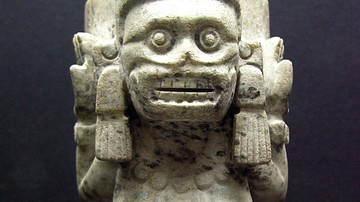
Mictlantecuhtli, God of Death
A stone vessel depicting Mictlantecuhtli the Aztec god of death and Lord of the Underworld.
National Museum of Anthropology, Mexico City.

Image
Lord Pacal
K'inich Janaab' Pacal otherwise known as Lord Pacal and Pacal the Great, 603-683 CE and Mayan king of Palenque. (National Museum of Anthropology, Mexico City)

Image
Throne of Motecuhzoma II
The Aztec Monument of Sacred War (teocalli) or throne of Motecuhzoma II. Carved in c. 1507 CE to commemorate the New Fire Ceremony of that year. (National Museum of Anthropology, Mexico City)
Image
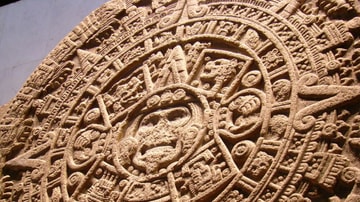
Tonatiuh, Calendar Stone
The Aztec Sun Stone (also known as the Calendar Stone) is a representation of the five eras of the sun from Aztec mythology. Some scholars consider the central face to be that of Tonatiuh, the sun god, while others maintain it is the night...

Image
Proclamation of the Independence of Peru
Proclamation of the Independence of Peru, oil on canvas by Juan Lepiani, 1904. Lepiani depicts José San Martín (1778-1850) declaring Peruvian independence on 28 July 1821 in Lima, Peru. National Museum of Archeology, Anthropology and History...
Image
Aztec Hummingbird Whistling Pot
The Aztec civilization of ancient Mesoamerica believed that dead warriors were reincarnated as hummingbirds or butterflies. These whistling pots often included such birds, and they were considered spiritual conduits. This fine specimen dates...

Image
Ehecatl, God of the Winds
A statue of Ehecatl, the Mesoamerican god of the Winds. The eyes are of obsidian and he wears his typical beaked mask. Aztec, Late Postclassic period. (National Museum of Anthropology, Mexico City)
