
Search
Did you mean: Aegina?
Remove Ads
Advertisement
Search Results

Definition
Sabratha
Sabratha was an ancient port city on the coast of North Africa (in modern-day Libya). The site was originally inhabited by the indigenous Berber Zwagha tribe in the 8th century BCE (according to the 11th-century CE historian al-Bakari...
Image
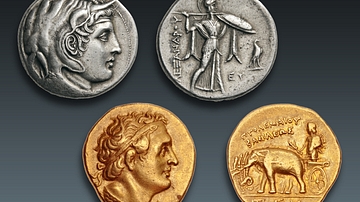
Elephant Symbolism on the Coins of Ptolemy I
Two coins issued by Ptolemy I: 1) A portrait of the deified Alexander the Great wearing an elephant scalp on his head, with a ram’s horn over his temple, and an aegis (sacred fleece) over his shoulder...

Article
A Visual Who's Who of Greek Mythology
Achilles The hero of the Trojan War, leader of the Myrmidons, slayer of Hector and Greece's greatest warrior, who sadly came unstuck when Paris sent a flying arrow guided by Apollo, which caught him in his...

Article
Athena Parthenos by Phidias
The magnificent temple on the Acropolis of Athens, known as the Parthenon, was built between 447 and 432 BCE in the Golden Age of Pericles, and it was dedicated to the city's patron deity Athena. The temple was constructed...

Article
Cyrus the Great's Conquests
The estimated expanse of the Achaemenid Empire at its height c. 500 BCE was two million square miles. Most of this territory was conquered by Cyrus the Great, the founder of the Empire, who reigned from 559 to 530 BCE...

Article
The Parthenon Sculptures
The extraordinary quality and quantity of the marble sculpture which adorned the 5th century BCE Parthenon in Athens made it the most richly decorated of all Greek temples. The sculpture, now mostly separated into the Parthenon...

Article
The Differences Between Byzantine & Armenian Christianity
Although both the Byzantines and the Armenians were Christian, the types of Christianity they professed had important differences that led to a lack of recognition and tensions between the two...

Image
Athena Statue
Statue of Athena wearing a Corinthian helmet, the aegis and Gorgoneion (detail), c. 180-190 CE. Liebieghaus, Frankfurt am Main.
Image
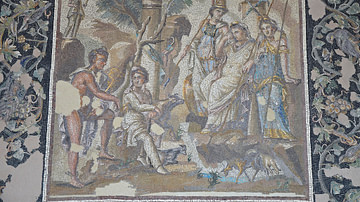
The Judgement of Paris Mosaic
Mosaic depicting the Judgement of Paris, one of the preliminaries in the Trojan War story. The mosaic, dating to the second century CE, adorned a dining room in the house of a wealthy Roman in Antioch on the Orontes...

Image
Bes Figurine, British Museum
Bronze figure of Bes, with aegis of Amun on his head, from the New Kingdom of Egypt.
The British Museum, London.
