
Search
Remove Ads
Advertisement
Search Results

Definition
Sidon
Sidon is the Greek name (meaning 'fishery') for the ancient Phoenician port city of Sidonia (also known as Saida) in what is, today, Lebannon (located about 25 miles south of Beirut). Along with the city of Tyre, Sidon was the most powerful...

Definition
Karnak
Karnak is the modern-day name for the ancient site of the Temple of Amun at Thebes, Egypt. The Egyptians called the site Nesut-Towi, "Throne of the Two Lands", Ipet-Iset, "The Finest of Seats" as well as Ipt-Swt, "Selected Spot" also given...
Definition
Hosea
Hosea is listed as the first of the twelve minor prophets in the Hebrew Bible. He was active in the 8th century BCE and his ministry extended over 60 years, from King Jeroboam II (787-747 BCE) to King Hoseah (731-722 BCE). He was one of the...

Definition
John I Tzimiskes
John I Tzimiskes was Byzantine emperor from 969 to 976 CE. Although he took the throne by murdering his predecessor Nikephoros II Phokas, John was a popular emperor. A skilled general and a competent politician, he is known for expanding...
Article
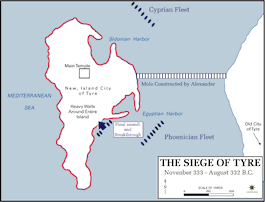
Alexander's Siege of Tyre, 332 BCE
After defeating Darius III at the battle of Issus in November 333 BCE, Alexander marched his army (about 35,000-40,000 strong) into Phoenicia, where he received the capitulation of Byblus and Sidon. Tyrian envoys met with Alexander whilst...

Image Gallery
Ships in the Ancient Mediterranean
The Egyptians, Phoenicians, Greeks and Romans all prospered in the ancient Mediterranean thanks to their mastery of the sea which allowed them to fish, trade, win naval battles and establish new cities far from their own coastal waters. In...

Article
The Hellenistic World: The World of Alexander the Great
The Hellenistic World (from the Greek word Hellas for Greece) is the known world after the conquests of Alexander the Great and corresponds roughly with the Hellenistic Period of ancient Greece, from 323 BCE (Alexander's death) to the annexation...

Article
A Visual Glossary of Classical Architecture
Abacus - a large slab placed above the column capital to support the architrave or an arch placed above it. Akroterion - a decorative piece added to the roof of a temple at the apex and corners, usually made of clay or bronze and often in...

Article
Saladin & the Unification of the Muslim Front: 1169-1187 CE
Saladin (c. 1137 – 1193 CE), the Muslim ruler who crushed the mighty Crusader army at the Horns of Hattin (1187 CE) and re-took Jerusalem after 88 years of Crusader control, was born in a world where the disunity of the Muslims had allowed...

Article
The AlUla World Archaeology Symposium 2024 - Three Days of Learning and Sharing Amongst Archaeologists
I was recently invited to an archaeological symposium at the site of AlUla in Saudi Arabia. I had known about AlUla since 2018 and seen photographs of the amazing Nabatean tombs from there. A conference was held at AlUla in 2023, but I was...
